We have seen plenty of college shot-blocking superstars who made it to the NBA: David Robinson averaged 4.06 BPG at Navy, Hakeem Olajuwon averaged 4.54 BPG at Houston, and Shaquille O’Neal averaged 4.58 BPG at LSU. However, the all-time record of 5.87 BPG was set by Keith Closs during his 2 years at Central Connecticut State in the mid-1990s and remains the record almost 30 years later. He played 3 years with the LA Clippers and averaged 1.3 BPG despite playing fewer than 13 minutes/game. HoopsHD’s Jon Teitel got to chat with Keith about being a spectacular shot-blocker and all the legends he faced in the NBA.
Your favorite player growing up was Kareem Abdul-Jabbar: why did you like him so much, and did you ever get the chance to meet him? He was my favorite because he was just everything as a basketball player. I grew up during the Showtime Lakers era so I liked all those guys like Magic Johnson/James Worthy/etc., but I just felt a connection to Kareem. I got to meet him when I was younger when I went to some of his games: a lot of people confused me for his son Kareem Jr. because we looked similar. I remember attending an All-Star camp in 1993 with Kareem Jr.: some kids came up to me and thought that I was Kareem Jr…and when I looked over to him he had run away and left me by myself! I met Kareem Sr. during my final year with the Clippers and we got to work together a little bit. In my opinion he is the GOAT of basketball because he won at every level.
In December 1994 in the 5th game of your freshman season at Central Connecticut State you had a career-high 13 BLK in a game against St. Francis PA: how were you able to come in and dominate right from the start? Coach Mark Adams let me: he believed in my talent and I love him to death. He told me that if I truly listened to him then I would lead the nation in BLK. Almost 30 years later my freshman record of 5.3 BPG still stands.
You led the nation in BLK in both 1995/1996: is it just about being tall or is there a lot more to blocking shots? Not every tall player is a shot-blocker. It takes timing and natural ability. I did not like when my opponents scored against us, which is what drove me to block so many shots.
You still hold the D-1 record for career BLK with 5.87 BPG: did you realize at the time how prolific a shot-blocker you were, and do you think that anyone will ever break your record? I did realize it back then: if I had stuck around for 1 more year then I would have broken all the records. Records are made to be broken so I think it will get broken eventually: for example, I never thought that LeBron James would break Kareem’s NBA scoring record…but he did.
You played 3 years for the Clippers: what is your favorite memory from your time in the NBA? I do not have 1 specific favorite memory but it was great to compete against the world’s elite every single day: even at practice we would challenge each other. I blocked Michael Jordan a couple of times and got to guard him on his home court in Chicago. My little bro Kobe (RIP) had never been able to dunk on me for a long time. I remember 1 game where I took a bad angle and swiped at nothing and he just double-pumped and finished strong at the hole. We called a timeout and he was so happy: he elbowed me in the ribs and knocked the wind out of me while saying, “I told you I could do it!” I also loved working with Kareem. 1 of my AAU coaches in high school taught me how to shoot a sky hook because it would set me up down the line, and it became a part of my game. I grew up playing on the perimeter, so when I had to post up I needed a sky hook/jump hook.
At 7’3” you remain 1 of the tallest players in NBA history: what is the best part of being so tall, and what is the not-so-best part (if any)? The best part is that I get the good air! The not-so-best part is that the world is made for short people. Even flying on an airline I get charged for extra legroom, while someone who is 5’1” can kick their legs all they want. I remember 1 flight to Europe where I could not even stand up in the aisle and some 5’5” people in the exit row would not switch seats with me. It was an uncomfortable flight but I did not make a scene because it was not worth it. I also cannot walk into a store and buy anything off the rack!
You later played in the USBL/CBA/ABA/D-League/abroad: what is the biggest difference between the NBA and every other league? Other countries train their players to be versatile, so even the big men can shoot from the perimeter and run the offense. You look at a guy like Arvydas Sabonis back in the 1980s: he did a lot of his work on the outside. I remember other guys like Dino Radja/Toni Kukoc: they were 6’10” but could do anything with a basketball. In the US we had a couple of tall ball-handlers like Magic Johnson/Scottie Pippen, but after the taller European players showed what they could so on offense the Americans started to adopt it more. The biggest game-changer of all was Dirk Nowitzki because everyone wanted a 7-footer who could shoot, and today you see guys like Kristaps Porzingis and my “long-lost love child” Victor Wembanyama! I love that big men can showcase the full extent of their skills because it makes the game more enjoyable to watch.
You 1st started drinking in elementary school, had a few DUI incidents in the NBA, and allegedly drank during games: how bad did it get, and how were you able to eventually turn your life around? As a kid walking through the projects in Hartford, CT, my father was an alcoholic and would buy me an 8-ounce can of beer so it became the norm. I chased that “buzz” for a long time: as I progressed through life I would keep alcohol in my high school locker, and I was suspended in college after walking into the wrong house and being charged with 3rd-degree burglary. I thought that I was just “having fun”, but after getting sober in 2007 I realized all the emotional damage I had done to my loved ones. It got so bad that I had a bout of acute pancreatitis and spent a couple of days in the hospital on life support.
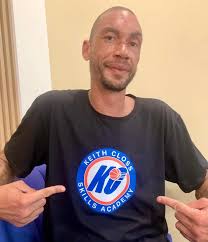
You now live in Costa Rica and host a skills academy: how do the skill sets of players in Costa Rica compare to those of kids in the US? It is not the same: the coaching/dedication/training/development is not on the same level. Costa Rica is a soccer country so it will take some time for basketball to make a comeback, perhaps during the next 5-10 years. We have a basketball program called the Keith Closs Skills Academy for kids ages 7–17, and people can follow us on Instagram at: @keithclossskillsacademy. We also aim to give opportunities to talented kids who do not have the resources, such as helping them secure scholarships, giving them equipment/balls, etc. We do a lot of charity work by visiting rehab centers, marginalized areas, and youth communities around the country. I give motivational speeches and hold basketball clinics to inspire them. Lastly, we have a foundation in progress that will help the youth of Costa Rica in many ways. Our mission is to guide youth toward sports and away from addictions or bad choices in general. Players can only go as far as their coach will take them, so I want to bring international coaches here for clinics to educate the local coaches on Xs and Os. There is so much potential here: people will tell me to come see a kid who is “so amazing”…but then I show up and see that they cannot dribble with their off hand or finish at the rim. I am trying to teach them how to switch into another mode and have the discipline to be hungry and go for it. You need to figure out what you cannot do well and then correct it. I tell them to not just wait to train with me: go to a park and play 2-on-2 or 5-on-5 and work on your game there.
When people look back on your career, how do you want to be remembered the most? As a solid defender…or the world’s greatest shot-blocker! If I had more opportunities in the NBA then I would have led the league in blocks. As far as a life legacy, I fell but got back up, and I took the lessons I learned to help other people. I am almost 50 and there are still plenty of people who want to use my past against me, but I just want to help kids/adults avoid the same pitfalls. Our experiences are not just our own: we go through them so that we can help someone else down the line get through their own situation and empower them to change their own lives. Look at all the things I have been able to accomplish as a direct result of getting back on track: I am resilient and cannot allow myself to stay down or disappoint myself.