The NBA Finals date back to 1947 (when they were known as the Basketball Association of America Finals) and the very 1st NCAA tourney was held in 1939. Olympic basketball competition is even older: it debuted as a demonstration event in 1904, and the men’s version became a medal sport in 1936, with the women finally getting their chance to go for the gold in 1976. The United States has dominated Olympic basketball competition from the start: the men have now won 17 gold medals in the 20 tournaments they have participated in during the past 88 years, while the women have won 10 gold medals in the 12 tournaments in which they have competed during the past 48 years. While we must wait 3 years until the 2028 Olympics in Los Angeles, HoopsHD’s Jon Teitel will fill the void by interviewing as many prior Olympic players/coaches as possible. We continue our coverage by chatting with Dan Hughes about his incredible coaching tree and winning a gold medal in 2020.
You played baseball/basketball at Muskingum University: how good of an athlete were you back in the day, and how did you 1st get into coaching? I was an average college basketball player who did not get onto the court a lot: I was a better baseball player. At age 7 my parents took me to watch the local high school basketball team and all I did was focus on the coach: from that day on it was all that I wanted to do.
After 6 years as an assistant coach for the Toledo men’s basketball team you became an assistant for the women’s team in 1996: what is the biggest difference (if any) in coaching men vs. coaching women? It is the most-asked question of my career. I do not find a lot of differences so I did not do anything differently. I think my style of coaching fit the women well: I tried to approach it by figuring out how the players learn the game.
You were a 2-time WNBA COY in 2001/2007: what did it mean to you to receive such outstanding honors? It was nice. Seeing the players celebrate and attend the press conference showed that we were all in it together. I felt there were some other years I might have deserved that award more, but you move on quickly after it is handed out.
You are the only coach in WNBA history to win a playoff series with 4 different franchises (Charlotte/Cleveland/San Antonio/Seattle): how were you able to have so much success while coaching in so many different cities? 1 of the better things I did as a coach was play to the strengths of my teams. If you are looking for the “Dan Hughes system” I would defy it because all those teams came at it differently. I maximized what we did well, which in turn gave confidence to the players.
In 2018 you won a title in your 1st year as coach of Seattle (and the team won another 1 in 2020 in the “Wubble” while you were away due to a high risk of COVID infection): did your role/style/philosophy change due to having such a ridiculously talented roster (Sue Bird/Jewell Loyd/Breanna Stewart/etc.)? Yes: I did not coach my Cleveland teams the same way that I coached my Seattle teams. Even though I was not right there with them in 2020, I was able to delegate/empower my staff every day via phone/text. I was very open to change and there were 2 influences who helped the most with that. 1 was Pat Summitt: I was constantly amazed at how she changed even though she was so successful. The other influence was the San Antonio Spurs organization, who also tried to find a better way even while winning titles.
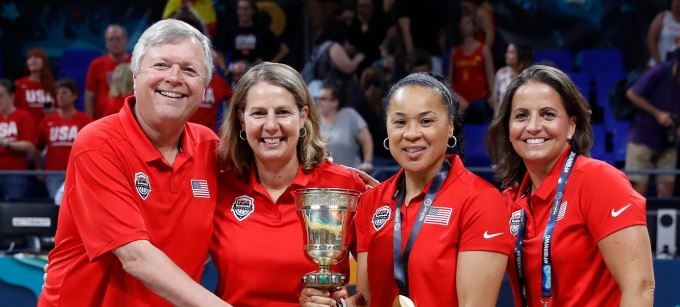
You were an assistant coach for Team USA at the 2020 Olympics: what did it mean to you to represent your country, and what did it mean to you to win a gold medal? Nothing means more in my coaching career than that. I spent 8 years working on the Olympic player selection committee, which was also special, but it was great to be coaching with a staff that included Dawn Staley (my 1st PG in Charlotte), Cheryl Reeve (my assistant in Cleveland), and Jen Rizzotti (who played for me in Cleveland). To go through that during the COVID era and finally win a gold medal meant a lot: it was the last time that I ever coached in a meaningful game.
In addition to Cheryl/Jen/Dawn your incredible coaching tree includes Becky Hammon/Suzie McConnell-Serio/many others: what is the secret to being a great mentor? There is a certain amount of fortune in that: I did not screw them up! I follow all my former players/assistants closely and get a lot of enjoyment out of that. For example, Becky will face Cheryl in the WNBA tonight when Minnesota travels to Las Vegas. Becky will try to break the franchise record of 12 wins in a row…which I set when I coached San Antonio in 2012! Empowering leaders was 2nd nature to me, although it is harder than it sounds. When you do that (especially with PGs), you must also intertwine your role as head coach to put the team in proper perspective. I feel very fortunate: I probably had the greatest arsenal of PGs that any coach has ever had, which made our teams look organized. That was a bit of my secret sauce: I gave them confidence, and we worked together so that the team would be talented going forward, which I am very proud of because they have all gone on to do some amazing things.
After retiring from coaching, you spent more than 2 decades as a TV analyst: how did career #2 compare to career #1? I never had a lot of hobbies besides listening to music, so broadcasting was my goal rather than getting out on the links. I loved it because it was the closest that anything ever came to coaching. Back in the day before a lot of money came into the WNBA, we were double-dipping in a lot of ways, which kept me sane. During the offseason I knew that I could do 15-20 games, which allowed me to pick up things just from being at shootaround and watching games. I met a lot of incredible people (such as Rick Barnes) and I got to work for ESPN at the NCAA women’s tournament for many years.
You have spent the past couple of years as Chief Basketball Advisor at VReps: what does that involve, and any predictions for how AI will impact coaching in the near or far future? It is an interesting story. I met Shawn Cooper (who developed VReps) a while ago and was very impressed by what he wanted to do. Shawn would often come to our practices when I went to Seattle, and then he reached out to me after I got out of coaching. He takes basketball apps and does some amazing things from a teaching standpoint. He came here to Ohio and when I put on the virtual reality gear it blew me away. The NBA is at the cutting edge of so many things including “Launchpad”, where they join forces with a young company that is trying to move basketball technology forward. We became a participant earlier this year and had a project in Dubai that went well. I think the NBA will roll out some things soon with VReps to teach the game across the world. I supply teaching/learning skills from basketball and it has given me great joy to move the game along.
When people look back on your career, how do you want to be remembered the most? At the core of everything, I want it to be about relationships. I hope they say that the people I coached/coached with went on to do great things. When people talk about what your former players/assistants have done: THAT is the legacy. I have won championships/gold medals…but it is another thing to see everyone else have success at multiple levels. Here is a stat for you: 14 of the last 16 WNBA champs were coached by either me, 1 of my former players, or 1 of my former assistants! I do not know if anyone else will have those kinds of numbers.