
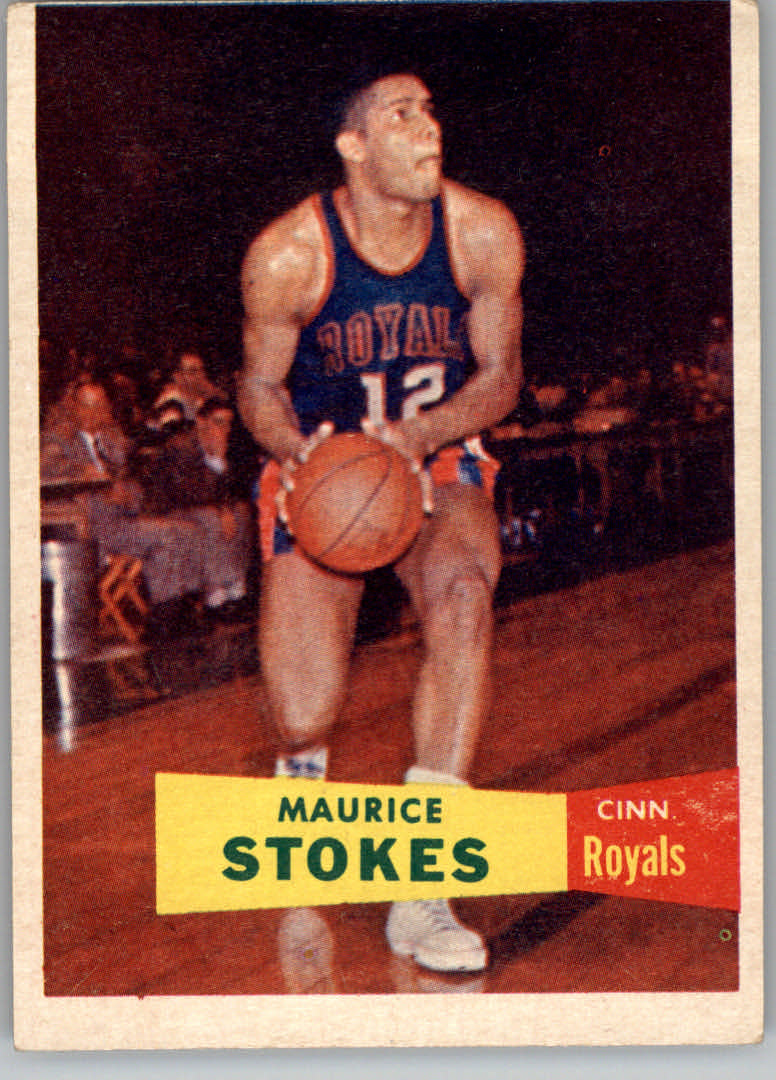
For a guy whose playing career ended at age 24, Maurice Stokes was still able to put together quite an impressive resume. He was named NIT MVP in 1955, NBA ROY in 1956, broke the NBA record for REB in 1 season in 1957, and made his 3rd straight All-Star Game in 1958. Even after his career-ending injury in 1958 he still lived for more than a decade and inspired everyone around him before passing away in 1970. HoopsHD’s Jon Teitel got to chat with Pat Farabaugh (St. Francis University professor of communications and author of “An Unbreakable Bond: The Brotherhood of Maurice Stokes and Jack Twyman”) about Maurice’s fantastic feats and lasting legacy.

Stokes grew up in Pittsburgh and led Westinghouse High School to back-to-back city championships in 1950/1951: what made him choose St. Francis for college? St. Francis coach Skip Hughes had Maurice on his radar and built a relationship with him. He had a few other offers, but his choice was primarily made due to Skip. Maurice’s teammate/friend Eugene Phelps was also invited onto the team that winter, which certainly helped them get Maurice in September of 1951.
He averaged 26.5 RPG as a junior, 26.2 RPG as a senior, and his 39 REB in a game vs. John Carroll in January of 1955 remains tied for the 6th-most in NCAA history: how was he able to be so dominant on the glass while standing just 6’7”? He was a very cerebral player who had very good instincts. He also had quick hands/feet and was very strong.
In the 1955 NIT the Red Flash finished 4th: how on earth was he named MVP?! Just look at his stats: 29 PTS/20 REB vs. Seton Hall, 21 PTS/22 REB against Holy Cross, 43 PTS/21 REB against Dayton, and 31 PTS/24 REB/10 AST in an OT loss to Cincy. The New York media was a little critical because he was so unselfish. It was an incredible individual performance.
He was also named an All-American that year: what did it mean to him to receive such an outstanding honor? It meant a lot to Maurice but it meant everything to the school: I would argue he remains our most famous alumnus. I was born the year that he died so I never got to meet him, but he put the institution on the map and set us up for all the players who followed.
He was selected 2nd overall by Rochester in the 1955 NBA Draft: did he see that as a validation of his college career, or the realization of a lifelong dream of reaching the NBA, or other? Abe Saperstein of the Harlem Globetrotters was trying to get him. Maurice wanted to compete against the best, and even though the NBA was still in its infancy; that was where the best players were. He was a perfectionist, so he wanted to see how his ability stacked up against others in the NBA.
He averaged 16.8 PPG/16.3 RPG as a rookie and was named ROY: how was he able to make such a smooth transition from college to the pros? I would not describe it as “smooth”: new players got beat up pretty good as a hazing ritual, and he was 1 of just a few African-American players in the NBA at the time. It was a trying year for Stokes: there was racism, especially when he played in St. Louis, and the other big men in the league tested him. His 1st year at St. Francis was also rough: he moved to a rural campus with just a handful of African-American students, and after his freshman year his brother died in a car accident.
During his 3 years in the NBA from 1955–1958 he had 3,492 REB (more than any other player) and 1,062 AST (#2 to Celtics’ PG Bob Cousy), and he is one of a handful of NBA players who recorded 4 consecutive triple-doubles: how was he able to balance all the different aspects of his game? He could do it all, so Royals coach Bobby Wanzer let him bring the ball up in transition. He was a student of the game and understood it well. He had a knack for rebounding but also piled up the assist numbers. In addition to Wanzer, the Royals’ owners gave him the green light to showcase his talents. I give their leadership a lot of credit for letting him play his game so that his talent could shine through.
During the final game of the regular season in 1958, he was knocked unconscious after driving to the basket and hitting his head on the court. A few days later after the only playoff game of his career, he became ill on the team’s flight back to Cincinnati, and later suffered a seizure and was left permanently paralyzed due to post-traumatic encephalopathy: what was the reaction like when people learned the tragic news? He was initially misdiagnosed as having something viral. People followed the NBA back in the 1950s…but the league had nowhere near the popularity it enjoys today. His accident was covered in newspapers, but it did not have staying power.
His friend/NBA teammate Jack Twyman became his legal guardian, which is depicted in the 1973 film “Maurie”: how unbreakable was their bond? They were both from Pittsburgh and played against each other in a city park and then again in the NIT. Jack was a shooter who never saw a shot he did not like, which sometimes frustrated Maurice, and they were not particularly close while they were teammates. After his injury, Jack would visit him in the hospital and they built a close friendship. Jack took on a lot of the burden to help Maurice pay his medical bills, became his legal guardian to take care of his finances, etc.
He died at age 36 from a heart attack in 1970, and per his final wish he was buried in the Franciscan Community Cemetery on the campus of St. Francis: when people look back on his career, how do you think that he should be remembered? He was a great player who was on a trajectory to be mentioned with guys like Bill Russell/Wilt Chamberlain, but I hope they primarily remember what happened after his injury. His perseverance was incredible: his daily therapy sessions often lasted more than four hours; he never missed a vote in an election after his accident; he regularly made gifts for his nurses, doctors, therapists and friends. He had limited mobility, but made the most of his life by building relationships. He would often help someone who was in a real funk get into physical therapy and see the positives: he was a glass-half-full guy. Twyman is also a big part of the story: in his 20s he made his entire home wheelchair-accessible on the chance that Maurice might move in with him some day. Jack’s kindness and selflessness are inspiring.
*TO SEE A VIDEO THAT SAINT FRANCIS PRODUCED ABOUT STOKES & TWYMAN, GO TO: www.youtube.com/watch?v=CiuEmqlmp18