The new college basketball season tips off today, which means that we have very little time left to prepare for the action ahead. We will do so via a series of season previews featuring the best players/coaches in the country. HoopsHD’s Jon Teitel concludes our coverage with St. Thomas coach Johnny Tauer, who talked about his team’s sensational shooting and his expectations for this season.
You played basketball at St. Thomas, where you made the D-3 Final 4 in 1994 and started 27-0 in 1995: how good a player were you back in the day? I was incredibly fortunate to play on outstanding teams, and for incredible coaches in both high school and college. In college, Steve Fritz and our assistant coaches taught me so much about the game of basketball and I was surrounded by outstanding teammates, many of whom are my closest friends to this day. In high school at Cretin-Derham Hall, I played basketball for legendary Coach Len Horyza and baseball for Hall of Fame Coach Dennis Denning. We won Minnesota State Championships in both sports, and I was blessed to play with incredibly talented players who were great teammates. Five of our baseball teammates were selected in the MLB Draft, including eventual Heisman Trophy winner Chris Weinke. I was never the star of a team but did enough to be All-State in both sports and an Academic All-American in college, primarily because I worked really hard, was coachable, and played on winning teams. I absolutely loved the balance we had on all of those teams, and that has impacted how I try to recruit and coach to this day.
After getting your doctorate in social psychology at Wisconsin, you returned to your alma mater as a professor/assistant coach: how difficult was it to balance your work in the locker room with your work in the classroom? This is my 26th year coaching at the University of St. Thomas, and I think back to those early years as a full-time professor and assistant basketball coach with young children and wonder how I found time for it all. Whether it was teaching a full load of classes, publishing research, serving on committees, recruiting, meeting with players, coaching practices, etc., there were not enough hours in the day. The benefits I had were an incredibly supportive family, that my kids were able to come to so many practices and have that be an integral part of their childhoods, and that I loved all of those aspects of both my work in the psychology department and on the court. When I became the head coach in 2021, I continued to teach (albeit a lighter course load), and once we jumped from Division 3 to Division 1, I felt like our travel schedule would preclude me from giving all I had in the classroom, although I still love giving guest lectures – there is something special about trying to spark curiosity and learning, both on the court and in the classroom!
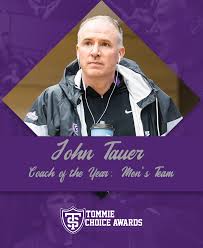
In 2016 as head coach you went 30-3, won the national title, and were named national COY: what did it mean to you to win a title? Winning a national title is surreal in the truest sense. All of the hours invested in every aspect of the program and people in it come together in a perfect confluence of events across a season, but really across three magical weekends in March. We had three goals in our program each year: Contend for a National Championship (Dare to be Great), win a conference title (sustained excellence based on Aristotle’s writing), and developing high character young men who behave in sustainably productive ways to benefit our world (based on Immanuel Kant’s Categorical Imperative). Winning a championship is one outcome of success, yet with hundreds of teams it cannot be the only goal, regardless of how good a program is. I was just at an alumni event yesterday and a wedding last week, and the long-lasting joy is not from winning a title but from the relationships and accompanying memories (and the stories that only get better over time)! There has been a lot of psychological research done on the challenges after winning a championship at any level in any endeavor – the goal is great, but the joy in the journey is what keeps people going and is the truly magical part of every season.
In 2001 you were inducted into the school’s Athletic Hall of Fame: where does that rank among the highlights of your career? I grew up around the University of St. Thomas (College of St. Thomas until 1977). My dad John is a 1963 alum and was the captain of the golf team. I watched the Tommies play from the time I was six years old, so receiving an honor like that brought me immediately back to those days with my dad, as well as all the players I had looked up to over the years, in addition to my teammates who were the real reason I ever did anything – they would be the first to tell you I did not have many skills outside of shooting 3s, and without guys like Mike Bergan, Matt McDonagh, Karnell James, Matt McDonagh, Jesse Radabaugh, and Brent Longval setting me up for easy shots, I probably would have struggled to score any points. Being inducted into a Hall of Fame with so many incredible athletes was very humbling for me. To see those teams coached by Tom Feely and Steve Fritz (we have had just 3 head coaches in 72 years!) and be mentioned alongside those guys was special. To share that with my parents John and Michele who have been so supportive in everything I have ever pursued in life was incredible.
You only won 10 games during your 1st year in D-1 in 2022, but have increased your win total in each of the past 3 years: how difficult was the adjustment from D-3 to D-1, and how were you able to get things turned around? I have said before that we are the “Coolest Story in College Basketball”. I am admittedly biased, but our story is truly unprecedented making it unique (not better or worse) relative to what every other school is doing. That first year will never happen again in Division 1 basketball. We literally started the exact same five guys who 6 months earlier had been playing Division 3 basketball. To win 10 games that year when we were arguably the smallest D-1 team in history was one of the most incredible seasons I have been a part of…it was not always easy – we lost 12 consecutive games at one point, but I have never been prouder of how a team competed than I was that season. Keep in mind, those players had lost a TOTAL of 8 games in our last three years of Division 3 basketball, and even though we lost more games that season in a month, never once did I question how strong our culture was. They were fearless, connected, and inspiring – the nine guys who made the jump from D-3 to D-1 helped lay the foundation for the 19, 20, and 24-win seasons we have had the past three years. That is the first time a transitioning team has won 19+ games in years 2-4, and all of the other schools jumped from D-2 to D-1. That is a long-winded way of saying the work in the transition has been endless for players, coaches, staff, and administration, but I do not look at it like we have turned anything around – rather, those guys that first season were instrumental in carrying a special culture from Division 3 to Division 1, and I will always be incredibly grateful and inspired by all the players on that team.
Your psychology research focuses on factors such as competition/cooperation: how crucial is player motivation to basketball success? Motivation is one of those ubiquitous words that requires nuance. Is the motivation intrinsic or extrinsic? Is it avoidant or approach oriented? Is it motivated by a fear of failure or desire for success? Is it driven by work goals, mastery goals, or performance goals? Motivation is the fire that burns inside people and obviously a topic I am very passionate about in my life. It impacts our program in myriad ways from recruiting to practice to film to games. That said, the word can be overused because it deals much more with what we do when nobody is around than a rah-rah speech or hype video. I spent 20+ years studying intrinsic motivation and was fortunate to be mentored by Dr. Judy Harackiewicz at the University of Wisconsin, where I learned a way of thinking that combined high level statistical analysis with scientific rigor to test hypotheses – something we do informally as coaches on a daily basis.
Last year your team was top-25 in the nation in FT%/2P%/3P%: what makes your team’s shooting so sensational? Great question, and one we get asked a lot. It starts with the players we recruit. They are Unselfish, Skilled, Smart, and Tough. Our offensive coordinator (Mike Maker) is a brilliant coach who does a tremendous job teaching and coaching our players. The other critical piece to our shooting success is passing. We emphasize passing each day in practice and demand our guys attend to details around this skill. If everyone buys into this, our passing makes everyone a better shooter. We have really good shooters who become even better because of their passing, coachability, decision making, and unselfishness. Our staff is comprised of Kenny Lowe (star player at Purdue) and Cam Rundles (star player at Wofford), Josh Rodenbiker, Kevin Schield, and Danny Johnson. Their tireless work in every aspect of our program creates a synergy that we hope mirrors how our players compete.
Your roster includes 7 players from Minnesota/5 players from Wisconsin: what sort of recruiting philosophy do you have? Recruiting is a two-way street. In Division 3 we had a track record of success that allowed us to target players who fit our system and really wanted to be a part of the University and all that it offered from a holistic perspective. That includes the academic rigor and reputation of UST to the vibrant metropolitan community of 3+ million people to the quaint college feel on our campus to the enormous alumni network. As we moved to D-1, it was understandable that some people wondered how this experiment would go, particularly when we could not qualify for the NCAA Tournament. We have focused our recruiting efforts on players and families who chose UST for all the right reasons and doubling down on culture has helped us directly and indirectly. Now that we are eligible for the NCAA tournament and we are opening the $183 million Lee and Penny Anderson Arena next week, we feel like our recruiting has become even more selective in terms of finding the right fit for our system and school. 60% of our starts the past four seasons have come from players who started their careers in Division 3, which is a testament to their development and team play to have had the success we have had our first four seasons in Division 1.
You had a birthday last month: what did you do for the big day? My wife Chancey, and our kids Jack, Adam, RQ, and Issa had dinner at our house and then I spent a couple days in New York City shooting hoops at West 4th St. while strategizing about the upcoming season and having wonderful dinners with close friends. The older I get, the more appreciate simple things with family and friends. Jack and Adam are both walk-ons on our team, RQ is a senior in high school, and Issa is in preschool so we have grad school, college, high school, and preschool all covered which makes every day an interesting one! Chancey co-founded a truly spectacular charter school 13 years ago (Prodeo Academy), so much of our time at home is spent with our kids and working at our passions.
What are your goals for the upcoming season, and what are your expectations for the upcoming season? We do not have tangible goals entering a season. We believe strongly that team stats and wins are merely a byproduct of the work we invest every day. Of course we want to win games, but we focus nearly exclusively on how we play and how that process translates into quantitative success. Qualitatively, my goal is for team to always compete like champions, playing Unselfish, Smart, Skilled, and Tough in a way that inspires our fans, alums, students, and basketball fans everywhere.