Many people think the Chicago Bulls did not exist before Michael Jordan showed up in 1984, but they were formed 2 decades before that and won a Midwest Division title in 1975. That 1975 team included several future Hall of Famers such as Rick Adelman, Jerry Sloan, and Nate Thurmond. The player who scored the most PTS that season (1461) was also a future Hall of Famer: Chet Walker. He originally made a name for himself in Illinois after twice earning 1st-team consensus All-American honors at Bradley, then became a 7-time All-Star in the NBA, and won a title with the 76ers in 1967. He passed away in 2024 but HoopsHD’s Jon Teitel got to chat with legendary Bulls sportswriter/New York Times bestselling author Sam Smith about Chet’s famous nickname and his incredible combination of durability/scoring ability.
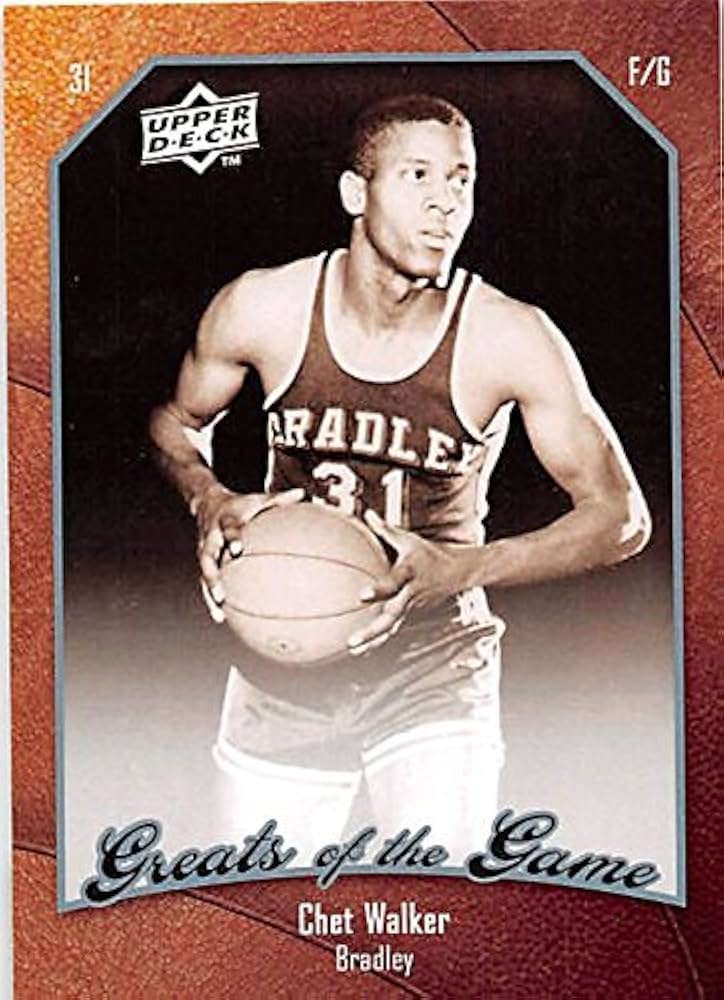
His nickname was “The Jet”: who gave him the nickname, and how did he like it? That was an era of alliteration/rhyming, but he was certainly not a “jet” on the court so I am sure that he enjoyed the irony! He was a half-court kind of player and must have gotten a kick out of that, as guys like Pete Maravich/Bob Love were more open-court players. His only teammate who was less of a “jet” was Tom Boerwinkle.
Walker and his mother had originally agreed that he would attend Nebraska: how did he end up at Bradley instead? He told me that it was not as uncommon a situation during that era as it seems today: there were a lot of young Black kids who were taken advantage of back then. For example, Joe Caldwell was ready to go to UCLA…but eventually got “kidnapped” and went to Arizona State. Chet had a similar story. Fred Hoiberg’s grandfather was the coach at Nebraska and had arranged for Chet to come there, but someone else intervened, took Chet to Illinois, and got him registered at Bradley. Chet just wanted to play basketball: it was not like his life’s dream had always been to attend Nebraska. Fred has confirmed the story as well.
He is the only Bradley player to be named a 2-time All-American and his #31 was retired by the school in 1976: where does he rank among the greatest players in school history? I think that he is the greatest: Hersey Hawkins is the only other contender I can think of, but he was nowhere near the player that Chet was. Hersey scored a lot of points, but that was a result of Coach Dick Versace playing an up-tempo style. Chet elevated the entire program, and when they won the 1960 NIT it was like winning an NCAA title today. He was caught up in the collegiate betting scandal back then and was interviewed by New York County District Attorney Frank Hogan. He did nothing wrong but not everyone agreed: he thought that he was poisoned at a hotel from a meal served by a bellman!
He was drafted 12th overall by Syracuse in 1962 and was named to the NBA’s 1st All-Rookie Team in 1963: how was he able to come in and contribute right from the start? He was just a high-level player with a lot of skills. He was 6’7” and told me that Red Auerbach was interested in drafting him, but Boston decided that John Havlicek would be a better fit because they needed defense more than offense at that time. If you look at the NBA today, Chet was a Kevin Durant/Pascal Siakam-type of player. He was long/lean/athletic, which also describes the premier forward of that era: Elgin Baylor. Chet had all the moves around the basket and was able to walk right into the league and become a scorer. He could have scored even more points had he not been teamed up with Wilt Chamberlain in Philly. He was his team’s “finisher”: when they needed someone to make the final shot, it was Chet.
In 1967 he scored 19 PPG for a 76ers team that won a then-record 68 regular season games en route to winning a title: how big a deal was it for them to snap Boston’s streak of 8 straight championships? It was huge because the Celtics were the greatest dynasty in American team sports history. Wilt was the biggest name in the game but could never get over the hump until Philly got a new coach in Alex Hannum, who ran the triangle offense. Wilt had more help than he had ever had before, and he trusted those guys. Chet and Wilt became close friends: they would travel to Europe together during the summers. There were not many guys who scored 20 PPG while playing with Wilt!
He was a 66% FT shooter in college but in 1971 he led the NBA with 85.9 FT%: how crucial was his FT shooting to his success? He had a great stroke and natural ability. He probably did not shoot better in college because the defenses were focused on him and beat him up.
He graduated as the all-time leading scorer in school history, and a decade later in February of 1972 he scored a team-record 56 PTS for Chicago in a win over Cincinnati: what was his secret to being a great scorer? That 56-PT game was 1 of my favorites. He was an All-Star for several seasons with the Bulls but did not make the All-Star Game in 1972 because it was hard to get noticed with so many other great players in his conference. After he was snubbed, he decided to show everyone that he could score: the only player in Bulls’ history to score more than that was Michael Jordan! He was a soft-spoken guy who was not that outgoing but was very prideful and had the ability to play at the level of the greatest players of that era. He was so difficult to stop due to his size/moves.
He was a plaintiff in a federal antitrust lawsuit against the NBA that was settled in 1976, but after Bulls owner Arthur Wirtz told him that he would be the Bulls “property” if he chose to play again, he decided to retire: what was the reaction to his decision, and did he have any regrets? He was a proud guy and an activist for certain causes. He was involved with Martin Luther King and was close to other NBA leaders like Oscar Robertson. It was not uncommon back then for players to hold out, and before that season Norm Van Lier/Bob Love both held out. The Bulls led Golden State 3-2 in the playoffs but ended up losing the series 4-3. Dick Motta was both coach/GM and he thought that the 2 hold-outs should not receive a playoff share, so Chet was unsure about coming back due to the way Motta treated his players. Milwaukee had great interest in signing him, and he wanted to go there, but he was nobody’s “property”, so he just walked away. I think that he would have liked to play a couple more years, but he got into the entertainment industry, won an Emmy, and became friends with Muhammad Ali.
He appeared in more than 1000 games but never missed more than 6 games in any of his 13 seasons: what was the key to his durability? He was the ultimate iron man. Basketball players have such amazing physical abilities but if they got hurt back then they could get cut. Chet played 80 games almost every single season. His statistics were good, but he was overlooked by Hall of Fame voters for many years because he played with Wilt. He was 1 of the truly elite players of his era and a good shooter and reminds me of Shai Gilgeous-Alexander: he could get into space and create his own shot. His size/elusiveness makes me think that he could have led the league in scoring.
He was inducted into the Hall of Fame in 2012 and passed away in 2024: when people look back on his career, how do you think that he should be remembered the most? He won an NBA title…but most people only remember Wilt from that team. He was 1 of the elite players of his era, an iron man, a committed player representative who stood up for his teammates. He is someone who players of the current era should recall because they are standing on the shoulders of guys like Chet/Oscar, who helped introduce free agency into the NBA. He was 1 of the great figures in the history of the game despite being overlooked. He resented the fact that the 76ers and Bulls never retired his number, probably because he divided his career between the 2 franchises and it was not popular in society back then to be an activist.