The NBA Finals date back to 1947 (when they were known as the Basketball Association of America Finals) and the very 1st NCAA tourney was held in 1939. Olympic basketball competition is even older: it debuted as a demonstration event in 1904, and the men’s version became a medal sport in 1936, with the women finally getting their chance to go for the gold in 1976. The United States has dominated Olympic basketball competition from the start: the men have now won 17 gold medals in the 20 tournaments they have participated in during the past 88 years, while the women have won 10 gold medals in the 12 tournaments in which they have competed during the past 48 years. While we must wait 3 years until the 2028 Olympics in Los Angeles, HoopsHD’s Jon Teitel will fill the void by interviewing as many prior Olympic players/coaches as possible. We continue our coverage by chatting with Texas A&M Hall of Famer Barry Davis about DeAndre Jordan’s time in College Station and the gold medal he won in 2016.
DeAndre was born/raised in Texas: what made him choose Texas A&M? At that time A&M was in a little stretch where they had brought in a new coach (Billy Gillispie) who had a great couple of seasons. It was looking on the up and up and DeAndre wanted to help take us to the next level and beyond. It was also close to home so his family could come watch him play.
Before DeAndre arrived in College Station, Coach Gillispie left to become head coach at Kentucky: how close did DeAndre come to also heading elsewhere? It was probably on his mind. He had already been committed for almost a year, but the style of play that he had been recruited under was very different from that of the new coach (Mark Turgeon).
In the 2008 NCAA tourney he scored 6 PTS off the bench but Donald Sloan’s potential game-tying layup in the final seconds was blocked in a 2-PT loss to #1-seed UCLA: how close did they come to pulling off the upset? It was a heck of a contest between 2 very talented teams. UCLA had about 5 guys who made the NBA: Russell Westbrook was not even the best guard on that team, if you can imagine that! We led for a majority of the game but it came down to the end: they were able to make a play and we were not.
He finished that season by being named to the Big 12 All-Rookie Team: how was he able to come in and contribute right from the start? He was always able to rebound, block shots, and run the floor for dunks off lob passes. We started out great that year and even beat Washington/Ohio State to win the Preseason NIT.
After the season he declared for the NBA Draft and was selected by the Clippers with the 35th overall pick: were you surprised that he turned pro without a guarantee of being selected in the 1st round? Everybody knew that he was a “1-and-done”: that was the expectation coming out of high school there was no doubt. However, he got injured toward the end of the year and also was ill: things did not fall the way they should have, which can cost kids a lot of money. It was actually a good fit because the Clippers needed a big man like him.
In 2015 he became the 5th player in NBA history to average 10+ PPG/15 + RPG/1+ SPG/2+ BPG during the regular season: what makes him such a great all-around player? His physical ability: he was not just big but also a very good athlete. At that time there were not a lot of people his size who could run/jump/rebound/block shots/defend the low post. If you did a redraft now I think that he would have gone a little bit higher!
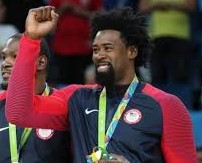
In 2016 he won a gold medal at the Olympics: where does he rank among the most accomplished players in school history? He was definitely 1 of the most accomplished players after his time here, but he was only with us for 9 months.
He is a great FG shooter (67.4 FG% is #1 all-time) but a terrible FT shooter (47.5 FT% is among the worst in history): any thoughts as to why he is so good at the former/so bad at the latter? He is so good at 2-PT shooting because he stayed within 15 feet of the basket. He could catch the ball and dunk it and continued to do that throughout his career. He continued to try to improve his FT shooting: it was not due to a lack of effort. Most big men do not spend much time practicing FTs when they are younger.
He is also 1 of the most durable players in the league (having played 360 straight games at 1 point): what is the secret to his work ethic? He was always reliable and a hard worker who loved to play the game. If you work backwards from there, that is the reason why he could do that. He would do whatever it took for his team to be in the best position to win.
When people look back on his career, how do you think that he should be remembered the most? He was an outstanding individual who continued to get better and is 1 of the best to ever play for Texas A&M.