How to fix the NCAA: HoopsHD interviews Constitution Committee member Greg Christopher

Earlier this month the NCAA Board of Governors appointed 23 members from across all 3 divisions to its Constitution Committee. The Committee will try to identify the key principles within college sports and help construct a new model that both preserves the existing values while allowing for concrete changes to be made in service of all student-athletes. Earlier today HoopsHD’s Jon Teitel got to chat with Committee member Greg Christopher (vice president for administration/director of athletics at Xavier) about how the process will proceed and how the Musketeers basketball team is looking for this fall.

Earlier this month the NCAA Board of Governors announced that it was appointing 23 members (including yourself) to its Constitution Committee that will “identify the core principles that define college sports and propose a new governance model that allows for quicker change without sacrificing broader values”: what are the principles that you believe in the most, and what are the most crucial elements of the new model? I think that college athletics has reached a bit of an inflection point so it is necessary to take a step back. When people have asked me about it in the past I mentioned that the NCAA manual is 451 pages, which we are not trying to rewrite! The constitution itself is relatively brief so the most central “non-negotiable” gets back to the tethering of academics to college athletics. Some people feel this idea is outdated but I believe very strongly in ensuring that our student-athletes are students 1st. I am also committed to broad-based programs with a wide array of opportunities/teams.

NCAA President Mark Emmert has stated that “The time is now for substantive change”: why now rather than 5 years ago or 5 years in the future? You probably could have picked anytime in the past decade but there is currently a lot of “noise in the system” and a continuous march of litigation, as well as conference realignment/equity review. We also need to see where the student-athlete voice fits into this in light of the NCAA v. Alston case because there are so many angles.

The Big East is well represented both by you and Georgetown President John DeGioia: what perspective do you 2 bring while coming from outside a Power 5 football conference? I am glad that our conference has a couple of voices at the table. I think it is a pretty representative group from across D-1. I know the Power-5 get a fair amount of attention but I am glad that there is a wide variety of voices.

The Board of Governors recently announced its historic decision to convene a special constitutional convention in November, which is “intended to propose dramatic changes to the NCAA constitution to reimagine aspects of college sports”: what part of the current constitution do you dislike the most, and what dramatic change are you most eager to propose? We have not really gotten to that point yet so it is premature to speculate. Our 1st step is to try to get some feedback: there was a survey sent throughout D-1 with feedback due early next week that will be compiled. In the months ahead we will pull out the major themes of the input, then craft some proposals by November.

You played football at Miami University in Ohio before your career was cut short due to injury: what impact has that injury had on your career in overseeing other student-athletes (if any)? “Played” is a liberal term! I had 1 too many concussions for my doctor’s liking. It is an invaluable opportunity to serve a new generation of student-athletes and live vicariously through them.

You also have connections to several other schools in the Midwest (worked at Purdue/Bowling Green and are now athletic director at Xavier): is it important to treat them all equally or do different kinds of schools deserve different kinds of constitutional oversight? My perspective is distinctive because my career path is unusual. Each of the 3 schools I worked at come from a different bucket within D-1. The Power-5 have different parameters within D-1 but it seems to work okay from a governance standpoint. However, since we have over 1000 schools within all 3 divisions, we might need to see how tethered the divisions should be to each other.

In 2018 you were named the Division I-AAA Under Armour Athletics Director of the Year and in 2020 you won the Mike Cleary Organizational Leadership Award: what did it mean to you to receive such outstanding honors? I think it is more of a reflection of the people who work around me and the team that we have. It is obviously appreciated and I feel humbled, but it is a recognition of the entire team.

What is the hardest part of being an AD during a pandemic, and how are things looking for the fall semester? The last 18 months have been challenging as we tried to work through it. We are an enterprise that is in disruption within an industry (higher education) that is in disruption. We are 2 weeks in but so far so good: we have a great group of athletes/coaches. There is less uncertainty this year than there was last year, when there was more anxiety. We were on campus last year, which not every other school was, but now that we are in the “2nd cycle” we have a better idea of how to operate.

The Musketeers made the NCAA tourney 26 times in 33 years from 1986-2018 but have not made it in any of the past 3 years: how much pressure does the program’s great track record put on current coach Travis Steele? I think that pressure comes every year, which is part of the fabric here at Xavier, and we embrace that. I think the past 3 years have gone about as we expected while Travis remade the roster, but at the end of the day we want to get into the NCAA tourney via the “final 2% of the climb”.

Last year the basketball team started 11-2 before losing 6 of its final 8 games: what are the expectations like for a roster that has a bunch of returning upperclassmen (including Nate Johnson/Adam Kunkel/Paul Scruggs/Ben Stanley)? We do have a lot of returnees. We got off to a hot start last year and then had 2 extensive COVID pauses that really threw a wrench into the continuity of how we were playing, which turned us into a different team. Nate Johnson’s injury did not help: when you lose 1 of the top 3-PT shooters in the nation (45.2 3P% last year), it makes it hard to win games.

Posted in Interviews | Tagged , , | Comments Off on How to fix the NCAA: HoopsHD interviews Constitution Committee member Greg Christopher

In Memoriam: HoopsHD interviews Len Trower-Mfuasi about Warren Jabali

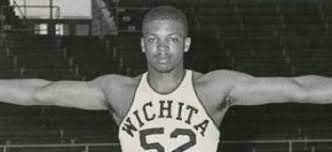
When you change your last name to the Swahili word for “rock” you need to be tough enough to back it up, and Warren Jabali did exactly that. A 3-time all-MVC selection at Wichita State, he chose the ABA over the NBA and paid immediate dividends by winning ROY, scoring 33.2 PPG in the 1969 ABA Finals, and being named Playoffs MVP. He was named an All-Star 4 times in a 5-year span from 1970-1974 and was All-Star Game MVP in 1973. Warren passed away in 2012 but HoopsHD’s Jon Teitel got to chat with Len Trower-Mfuasi about his best friend’s scoring/passing/defending. Warren would have turned 75 today so we take this time to reflect on his life/legacy.

Warren played at Central High School and is still considered 1 of the greatest players to ever come out of the Kansas City area: why did he decide to go to Wichita State? He did not come from a family of people who went to college so he learned the game in the backyard of a segregated community. He did not have his eye on any particular college but received a lot of offers. He went to Kansas for a visit but did not like the culture there. When he went to Wichita and met Dave Stallworth and others who were from the Black community and saw them all partying together, he decided that he liked that atmosphere.

He was a 3-time All-MVC selection: how was he able to be so dominant throughout his college career? I am sure that he worked on his game but he was also gifted. He was built like a football player and could jump incredibly high. He could handle the ball like a 5’10” PG and could pass like Steve Nash: his skills were just instinctive. He could drive and dunk and had a pretty decent jump shot, and was also pretty fast for a guy of his size in that era. You could not steal the ball from him because his hands were extremely strong. I am only 5’10” and I measured my hands against his once: he did not have hands much bigger than mine but he was so strong. He loved to set up his teammates.

In the summer of 1968 he was picked 44th overall by the Knicks in the NBA draft but decided to sign with Oakland after they picked him in the ABA draft: why did he go with the ABA instead of the NBA? If I recall correctly it had something to do with the money. I think he just got a more attractive offer from the ABA.

He was named ROY after scoring 21.5 PPG and helping his team improve from 22 wins the year before to 60 wins: how was he able to come in and help turn things around so quickly? Again, I do not think he knew how talented he was in relation to other players. I am not sure who else was on that Oakland team. It was like LeBron James: he had the same impact in terms of scoring/passing. Teammate Rick Barry once said that Warren was superior to Oscar Robertson in REB/AST!

He scored 33.2 PPG in the 1969 Finals vs. Indiana en route to winning the title and being named playoff MVP (becoming the only rookie guard in NBA/ABA history to be named Finals MVP until Magic Johnson did so in 1980): what did it mean to him to win the title, and how did it feel to win such an outstanding honor? He won that in part because Barry was injured in the playoffs. He never talked much about awards: his focus was on the condition of African-American people at the time and he was not the most social person. Most athletes were coddled people who just cared about parties but Warren was a student of current events. I am sure that it meant something to him but he never discussed it during the 47 years that we were friends. He was a serious-minded person.

Take me through the 1973 All-Star Game (which is often referred to as “Jabali’s Jamboree”):
He had 16 PTS/7 AST/3 STL and made the only 3-PT shot of the game en route to being named MVP: how was he able to play his best against the best? Because he was just as good as everyone else, if not better.

The very next day he was placed on waivers and was not picked up by any other team (allegedly for doing something during All-Star Weekend that embarrassed/enraged all the owners): what did he allegedly do, and did he think it was a racial thing? He told me that he found out that they were going to give the players a cheap watch in exchange for playing in the game, and he considered that to be an insult. He started organizing the players to boycott the pregame dinner with the players/owners and some of the players did indeed boycott: I was told that Dr. J initially agreed before changing his mind at the 11th hour. He always thought in the back of his mind that it might be racial: how else do you go from being MVP to being unemployed in a 24-hour span?! He had a reputation that mischaracterized who he was so the incident was just the straw that broke the camel’s back.

In February 1975 he scored 23 PTS for San Diego in a 176-166 4-OT win over the Nets (Julius Erving scored a career-high 63 PTS), which at that time was the highest scoring game in the history of pro basketball: where does Dr. J’s performance rank among the greatest you have ever seen? He told me that it was an incredible game where Erving did anything he wanted to do, but the guy Warren spoke most highly of was Roger Brown of the Pacers.

A few months later at age 28 he had to retire due to knee problems: how frustrating was it for him to not be able to go out on his own terms? He could still play but I think that he just had no place to go, like Allen Iverson. Nobody wanted to pick him up because he was “damaged goods” in terms of his legs/personality. He was frustrated but there were other things off the court that he could do so it did not bring him down in spirit.

His 2389 career AST remain #6 in ABA history: how was he able to balance his passing with his scoring? When you can pass and handle the ball as well as he did the defense could never tell what you were going to do, so he could fake passes and go to the hole. The media lumped John Brisker along with Warren as the “bruisers” in the sport. He had creative moves way back then, just like Earl Monroe. I got the chance to play against Monroe once: talk about humiliation! Look at a guy like Tony Parker: you knew that he was going to either drive to the basket or pull up for a jumper, but if you were back on your heels then you never knew exactly what he would do.

He had a reputation as 1 of the most feared defenders in the league: what was his secret for playing great defense? He had quick hands and was feared in part due to his reputation: you would not use your elbow to push him away because he would come right back at you. Nowadays you can get called for a foul just by touching a guy’s fingernail. Back then the refs had personal attitudes towards certain players…so when he got tripped by someone and no call was made he would just step on his opponent! He had good lateral movement and could elevate high enough to send his opponent’s shot back.

Warren passed away in 2012: when people look back on his career, how do you think that he should be remembered the most? Warren said he does not consider himself to be 1 of the greatest of all time but I told him that his modesty was ridiculous. If you look back on his skill set in addition to his stats you can see how good he was. He was 6’2” and could hit his head on the rim during high school. I definitely think that he should be included in the top-50 greatest players of all-time. When Barry went down during the championship run Warren took over and averaged 30 PPG. He was making a lot of moves that Michael Jordan later performed during the 1990s.

Posted in Interviews | Tagged , , | Comments Off on In Memoriam: HoopsHD interviews Len Trower-Mfuasi about Warren Jabali

Happy Birthday!: HoopsHD interviews Wright State legend Bill Edwards

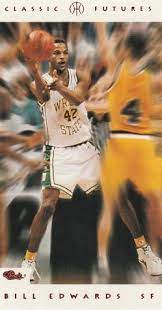
Bill Edwards is Ohio through and through: born in Middletown, high school in Carlisle, and college in Fairborn. By the time he left Wright State in 1993 he had become the best player in school history: 1993 MCC POY/tourney MVP, a trip to the 1993 NCAA tourney, and the greatest scorer/rebounder the Raiders had ever seen. He followed up a short NBA career with a very long European career before returning to his alma mater to showcase his strength and conditioning skills. HoopsHD’s Jon Teitel got to chat with Bill about scoring 45 PTS in a game and winning a bronze medal. Today is Bill’s 50th birthday so let us be the 1st to wish him a happy 1!

Your nickname at Wright State was “Dolla Bill”: who gave you the nickname, and how did you like it? In my sophomore year there was a local reporter who said that “if you gave him the ball, it was like money in the bank”: it just took off and everyone called me that. After I turned pro people thought that the nickname was because I had money!

In December 1992 you scored a school-record 45 PTS (20-30 FG) and had 13 REB in a win over Morehead State despite getting taken out of the game with 5 minutes left: was it just 1 of those scenarios where every shot you put up seemed to go in because you were “in the zone”? Yes: I felt really good in that game. I joked with my coach that he should have left me in: I did not know how many PTS I had but on nights like that you never want to come out.

In 1993 you scored over 25 PPG and were named conference POY: what did it mean to you to win such an outstanding honor, and did you feel like you were 1 of the best players in the country? It was hard to judge myself against other players around the country: I just did whatever it took to help my team win. We all had roles and my role was to score/rebound. It was an honor but I never tried to attain POY awards.

What are your memories of the 1993 NCAA tourney (you scored 18 PTS in a loss to Indiana, who was led by 29 PTS from Calbert Cheaney)? It was a rough 1 for us in our 1st-ever trip to the NCAA tourney. We were hoping to go somewhere warm…and they sent us up the road to play the Hoosiers in Indianapolis! They had a great coach in Bobby Knight and a good team: Cheaney, Greg Graham, etc.

You remain the all-time leading scorer/2nd-best rebounder in school history: did you realize at the time how prolific a player you were, and did you think that anyone would ever break your records? Scoring was just something that I did starting back in high school. God blessed me with the ability to score but I never thought that my records would last 20 years. I was only 190 pounds when I arrived in college but just had a knack for knowing where the ball would come off the rim. The only reason I had the rebounding record (which was broken by Loudon Love last season) is that kids these days just do not do the little things. I am amazed that schools cannot recruit kids to just rebound the ball because every team needs a good rebounder.

Despite not getting drafted you ended up playing 3 games for Philadelphia in 1994: what is your favorite memory from your brief time in the NBA? I did not have too many good memories because we were 1 of the worst teams in the league that year (25-57). It was fun to play with guys like Moses Malone: he was very down-to-earth.

At the 1998 FIBA World Championship your team held a 10-PT lead with 3 minutes to play, but Serguei Panov went coast-to-coast for a layup with 4 seconds left to clinch a 2-PT win by Russia: what did it mean to you to play for team USA (no NBA players were on the team due to labor problems), and where does the Russia game rank among the most devastating losses of your career? It was an honor to represent my country after the lockout, which I never expected to happen. The Russia loss was hard because we spent our entire summer trying to win a gold medal. It hurt, but it was still gratifying to win the bronze.

You played professionally overseas for 12 years: what did you learn from that experience, and how did it compare to college basketball? I liked playing overseas even though I did not know what to expect. The game was a bit rougher because you would have to beat your man and then beat someone else because there was no illegal defense. I know that a lot of guys get homesick and end up coming home but it never bothered me…as long as my check arrived on time! I kept some of my money in my freezer: whenever I thought about getting back to the US I would just open up my freezer and count my money.

Your son Bill Jr. played for Penn State/Miami Ohio: why did he decide to switch schools? I think he transferred because he was homesick, even though he denied it. It bothered me when he left because I knew that Miami was not the best fit for him. He called me the 1st week he was in Miami and told me that he was thinking of leaving. It was a big change to go from the Big 10 to the MAC.

You later became an assistant strength and conditioning coach at your alma mater and took classes to get your undergraduate degree: how did you like the job, and what is the post-graduate plan? It was a new experience to be a strength and conditioning coach: I never realized there was so much else to it besides lifting weights but I was happy for the opportunity. After graduation I hope to continue coaching at the next level or maybe head overseas.

Posted in Interviews | Tagged , | Comments Off on Happy Birthday!: HoopsHD interviews Wright State legend Bill Edwards

The Olympians: HoopsHD interviews Jim Sumner about 1964 Olympic gold medalist Jeff Mullins

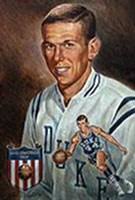
The NBA Finals date back to 1947 (when they were known as the Basketball Association of America Finals) and the very 1st NCAA tourney was held in 1939. Olympic basketball competition is even older: it debuted as a demonstration event in 1904 and the men’s version became a medal sport in 1936, with the women finally getting their chance to go for the gold in 1976. The United States has dominated Olympic basketball competition from the start: the men have won 16 gold medals in the 19 tournaments they have participated in during the past 85 years, while the women have won 9 gold medals in the 11 tournaments in which they have competed during the past 45 years. HoopsHD’s Jon Teitel continues his coverage by chatting with Jim Sumner (columnist for Go Duke: The Magazine and Duke Basketball Report) about Jeff Mullins making back-to-back Final 4s and winning a gold medal.

Mullins is 1 of many Olympic gold medalists born in Queens (including Bob Beamon/Vincent Matthews/Al Oerter) and went to high school 2 miles from the Kentucky campus in Lexington (where his wife Candy became a cheerleader): what the heck did they put in the water in Astoria, and what made him choose Duke? His father worked for IBM and the family moved to Lexington when Mullins was in high school. He went to high school there for at least two years, maybe three, but did not grow up dreaming of playing for Adolph Rupp. Mullins had a high school teammate in Lexington named Jon Speaks. Rupp came to practice 1 day and offered Speaks a scholarship. Speaks asked for a day or two to think about it and Rupp got upset and pulled the offer. Mullins saw a side of Rupp that he did not like. Speaks ended up as an All-ACC guard at NC State but died tragically in an automobile accident in 1963. Coach Vic Bubas was just starting to establish his program at Duke. He had to convince Mullins that he could coexist with Art Heyman, who was a year ahead of Mullins. Bubas told Mullins that Heyman was a willing and skilled passer and he was correct. Mullins averaged over 20 PPG in the two seasons that he and Heyman played together.

In the 1963 NCAA 3rd place game he had 14 PTS/10 REB in a win over Oregon State: how did that tourney run in 1963 help the team prepare for another great effort in 1964? Heyman was a senior in 1963 and won all of the national POY awards so I do not think there was any wait-until-next-year attitude. Duke went into the 1963 Final Four on a 20-game winning streak and expected to win it all. That said, starters Mullins/Jay Buckley/Buzzy Harrison returned as seniors in 1964, and top reserves Hack Tison/Denny Ferguson moved into starting roles as juniors. So, it was a veteran team that was coming off of Duke’s first Final Four season.

Take me through the 1964 NCAA tourney:
In his opening game on Friday the 13th he scored 43 PTS/19-28 FG and had 12 REB in a win over Villanova (including a 45-footer to end the 1st half): was it just 1 of those scenarios where ever shot he put up seemed to go in because he was “in the zone”? The NCAA Tournament was not seeded in those days. Duke was ranked third and Villanova was seventh in the AP poll. They matched up in an East Region semifinal but everyone knew that this was the title game. Villanova started two players (Wally Jones and Jim Washington) who would become longtime NBA starters and a 3rd (Bill Melchionni) who would become an ABA star. As an aside, Melchionni’s younger brother Gary/nephew Lee both later played at Duke. Villanova’s leading scorer was a 6’4” forward named Richie Moore. Mullins grabbed 12 REB and held Moore to 8 PTS (10 below his average) and forced him into 5 turnovers. That half-court shot gave him 28 PTS by halftime and put Duke up 49-33 at the half. A great player rising to the occasion with a great all-around game.

In the title game he scored a team-high 22 PTS in a loss to UCLA: how close did they come to ruining the Bruins’ undefeated season? After the Villanova game Duke beat Connecticut by 47 PTS in the East Region finals. Duke was then matched against a great Michigan team featuring two All-Americans in Cazzie Russell and Bill Buntin. Michigan had embarrassed Duke 83-67 earlier in the season at Ann Arbor and Duke really wanted revenge. Russell was the best player on the court (31 PTS/13-19 FG) and Mullins was pretty good (21 PTS/8 REB). However, the 6’10” Buckley outplayed Buntin in the best game of his career with 25 PTS/14 REB as Duke won 91-80. In the other semifinal Kansas State led undefeated and top-ranked UCLA much of the game before falling at the end. The Duke players saw part of that game but not UCLA’s comeback because the coaches wanted to get them some rest. Remember that the Final Four was held on Friday/Saturday in those days. Duke had expended a lot of physical/emotional energy in beating a talented and really physical Michigan team so there was not much time for them to recover/prepare for a UCLA team that thrived on its zone press. Duke led UCLA 30-27 in the first half when they let down their guard. UCLA’s press forced some live-ball turnovers, which they turned into layups. The lapse only lasted a few minutes but before Duke regained its composure UCLA had run off a 15-0 burst and turned that 3-PT deficit into a 12-PT lead. Duke never again got closer than 8 PTS. It is hard to argue the results of an undefeated team winning the national title game by 15 PTS.

As a senior in 1964 he was named All-American/ACC Athlete of the Year/MVP of the NCAA Eastern Regionals: what did it mean to him to receive such outstanding honors? As good as Mullins was in 1962/1963 (and he was very good), Heyman still got the lion’s share of acclaim. Mullins proved that he could carry a team in 1964: not by himself of course, but he was the undisputed star on a Duke team that went further than any other Duke team up until that time.

He scored 21.9 PPG during his college career and had double figures in each of his 86 games: what was his secret for being a great scorer? He was very versatile and a great shooter: he could score in transition, get to the line, and then convert from there. He also averaged 9 RPG at Duke, which was pretty good for a 6’4” 185-pounder. He was known for his ability to use the backboard and was a very creative scorer.

That fall as a member of team USA he missed the 73-59 win over the USSR in the final with a knee injury: what did it mean to him to win a gold medal despite not getting to play the last game? He obviously would have liked to have been healthy.

He was named an All-Star 3 straight years from 1969-1971 and helped Golden State win an NBA title in 1975 by sweeping Washington: how do you view his pro success as compared to his college success? Mullins probably never gained the recognition he deserved for his NBA career. He was not on national TV very much and the Lakers absorbed what little attention the West Coast got from the Eastern media. His teammate Rick Barry was better and certainly flashier and Mullins was on the downside of his career by 1975 as a role player. For seven seasons or so he absolutely was one of the NBA’s best guards and had some great playoff performances…only they took place in the middle of the night on the East Coast and were not really publicized.

In 1985 he was hired as head coach/athletic director at Charlotte, where he set a school record with 182 wins over 11 seasons and made 3 NCAA tourneys: why did he get into coaching, and what did he learn from College Basketball Hall of Fame coach Vic Bubas about how to succeed on the sideline? Bubas was known for two things: recruiting and organization. UNC-Charlotte caught lightning in a bottle in 1977 with Cornbread Maxwell and Lew Massey but they never really had the resources to recruit against the ACC. Mullins was an outstanding coach and teacher.

His #44 jersey was retired in 1994 and in 2002 he was named as 1 of the 50 greatest players in ACC history: when people look back on his career, how do you think that he should be remembered the most? Along with Art Heyman, Mullins was a key part of Duke’s first truly great teams and deserves all of the honors that he has received.

Posted in Interviews | Tagged , , | Comments Off on The Olympians: HoopsHD interviews Jim Sumner about 1964 Olympic gold medalist Jeff Mullins

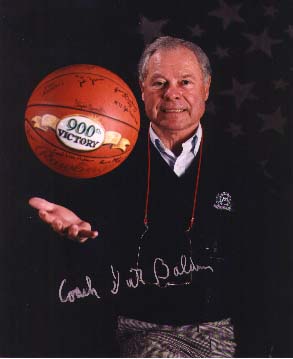
In Memoriam: HoopsHD interviews several people about former coach Dick Baldwin

You might not recognize the name Dick Baldwin but perhaps you should. He spent 40 years as head coach at Broome Community College, then 5 more at Binghamton in the 1990s. He was so successful that he actually surpassed the legendary Adolph Rupp to become the nation’s all-time wins leader at any level when he got #876 in the 1980s. His final stats are mind-boggling: 1302 games and 961 wins (which means he won almost 75% of his games). HoopsHD’s Jon Teitel got to chat with Jim Norris (1 of his assistant coaches), Tim Schum (1 of his golf buddies), and Sandy Thomas (1 of his daughters) about Dick’s leadership as a player and his near-half-century as a coach. Dick passed away in 2011 but today would have been his 100th birthday so we take this time to celebrate his life/legacy.
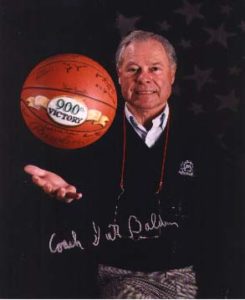
Dick got the ironic nickname “Biggie” in college because he was the smallest man on the team as a 5’8” forward: who gave him the nickname, and how did he like it? Sandy Thomas: My dad seemed to have gotten the nickname “Biggie” at the beginning of college or during high school. The Rochester newspaper articles used it from the get-go. Dad’s biggest regret at the end of his career was dropping the nickname, although I am sure he did so for my mom because she did not seem to like nicknames. Tim Schum: First off, I believe he was what 1 might refer to today as a “point guard.” He ran the show even though it was an extremely intelligent team: 2 of his teammates (John Baynes and Dick Baroody) later became very successful high school coaches in the Rochester area. I do not know exactly who gave him the nickname but I believe it was in reference to the fact that he “played big” or had a presence much bigger than his stated height. He was a tremendous competitor who never gave an inch. As a player at Rochester he was part of a group known as the “Four Bs” that led UR to some of its greatest seasons: Baldwin, Baynes, Baroody, and James Beall. Perhaps 1 of them gave him the nickname? In any case, I never heard him complain about it. Before I relocated to Binghamton to begin my own coaching career in the community, I recall people at UR always referred to him by his nickname but rarely did I hear people in the Binghamton community refer to him as “Biggie.”

He was captain of the basketball team: what was his secret for being a good leader? ST: My dad had some very important men in his life that he met through school and sports. His father died when he was 9 and my dad ended up at an Episcopal Military Prep School in Niagara Falls called DeVeaux. Charlie Metz was his coach/teacher: I believe he mentored my dad and inspired him to go into coaching. Dad played under many different types of coaches in college: his football coach was Dud DeGroot (who later became coach of the Washington Redskins) and his basketball coach was Lou Alexander. Daily News writer Wayne Coffey once wrote, “There is a solidity and steady going wholesomeness about Baldwin that evokes a bygone era: he would have fit very nicely in ‘Hoosiers’.” Jim Norris: Coach Baldwin was decisive, thorough, fair, well-organized, and a man of great integrity. Those qualities made him a good leader but most of all he led by example. TS: I think that he had an ability to maximize/merge his native physical ability with an ability to dissect a game and make good decisions under pressure. I offer this after watching him coach and being his golf partner. The bigger the challenge, the better he performed. I assume that was how he played every sport he tackled: he played football(!) as well as basketball and golf at UR. Perhaps more than most coaches I have come across, Dick was way above average in terms of intelligence. I believe he led not only by example but could also inspire his teammates by relating to them on an individual basis. In summary, he never asked for any quarter and never gave any. That has to have been a quality that endeared him to his teammates and (later) his players.

He spent 3½ years in the Army Air Force during WWII as a mechanic/pilot instructor: what impact did his military service have on him either on or off the court? ST: I think the greatest impact was when his younger brother Babe died. Dad even tried to switch over to the Infantry: he was a bomb sight mechanic who taught soldiers how to use the devices. TS: It must have further honed the leadership qualities he demonstrated in college. I know that he remained in great physical condition: he mentioned to me that the service utilized soccer (a sport I coached at Binghamton) as a training game and he came to appreciate the sport via that introduction to it. I think the service must have also given him a certain perspective on life. I believe the loss of his brother was something that he never got over. Obviously the service demands discipline and I always felt he was a highly-disciplined individual.

In 1947 he was hired at Broome Community College as a coach in several sports (basketball/golf/baseball/cross country) and as a professor of English: why did he take the jobs, and how did he like teaching? ST: My dad was one of the first professors hired at Broome Tech after WWII. Coaching was never his main job: he was actually a professor/athletic director. He approached teaching and basketball alike: be prepared/patient, and expect hard work and good results. My dad brought a typed “lesson plan” to each and every practice: he thoroughly prepared for every practice/game. JN: Coach Baldwin loved teaching regardless of the subject and felt that coaching was teaching. Most coaches develop plans for their practice sessions but Coach Baldwin developed “lesson” plans and always referred to them as such. TS: I think he saw Broome as a place where he could impact the growth of the school in a positive manner. Not that it was evident at first but it offered him the type of control that he liked. President Cecil Tyrrell was a “basketball guy” from the Midwest who even played with John Wooden at Purdue so it was a perfect marriage from an administrative standpoint. As far as teaching was concerned, Dick was a natural teacher. He identified a subjects’ goals/objectives and designed a plan to evaluate how his students achieved them. Whether it was a class like English or a sport like basketball he viewed the subject matter as a means to change behavior.

He also spent almost 4 decades as athletic director: how did he balance being an administrator with being a coach? ST: By being organized. In 1975 my son (who became his namesake) was born. Dad was supposed to be in California to give a presentation at a basketball conference but he came to see his grandson instead, so the conference asked legendary coach Adolph Rupp to fill in for him!

He won 879 basketball games at Broome and in the 1980s he actually surpassed Adolph Rupp as the “winningest college basketball coach in history”: what made him such a great coach, and do you think that he will ever make the Hall of Fame? ST: He was like a “chess master” moving the players around the court, especially when the rules allowed a slow-down game. He was really good at that and had the advantage when outmanned. He had integrity, knew the rules, and abided by them to the letter (both in basketball as well as golf). He was innovative: 1 season he used 9”X11” signs with pictures designating the plays. I made the signs myself: 1 was a “catbird” that I designed. 1 season they pulled out 5 small stools during the timeout huddles that allowed the players to rest. His 1st major player from NYC was Frank Streety, who wore the number “00” and later played with the Globetrotters in the mid-1960s. His assistant coach Jim Norris said that my dad had integrity, was a motivator, and a man of few words. He rarely raised his voice and was positive/humble/confident. He was cerebral in his approach to the game. Dad had 961 wins in his career: he often said that “THE EFFORT to win is everything” and believed that “winning is everything.” He also believed that coaching at a 2 year school was especially hard because every year you were creating a new team: getting to know new players, figuring how they fit together, etc. Dad is currently in 5 Halls of Fame and I think that he will eventually be in 6. JN: Coach Baldwin was an incredibly intense competitor who hated to lose. He knew and understood both athletics and people very well and his teams were always very well prepared. He had the unique ability to determine the strengths of his players and then get them to play to those strengths. He focused on what a player could do as opposed to what he could not do. Aside from insisting on playing by the rules and doing things the “right way”, Coach Baldwin was also a firm believer in being persistent and having a positive attitude: his teams always exhibited these qualities. I would say without hesitation that the Hall of Fame is absolutely warranted and deserved but I am doubtful that it will ever happen. I personally nominated Coach Baldwin during the spring of 1992 and completed the extensive nomination/application process but I never felt that his accomplishments/credentials were ever given serious consideration. Sadly, I think the HOF is more interested in inducting people affiliated with professional, Olympic, and “big-time” college basketball organizations as opposed to a true educator/coach who chose to spend his career positively impacting lives in a small community on a smaller stage. TS: Unfortunately his political “reach” was a bit regional in nature and within that region he probably did not engender in his fellow JUCO coaches/administrators the type of warm feeling necessary for HOF support. Objectively, Dick was not a very good loser. He liked being in control to such an extent that he could not stand not winning. He told me that he felt he would never get national JUCO support until perhaps Coach George Killian was 1st inducted. George was coach at Erie CC and he and Dick battled annually for regional basketball supremacy. Later George moved on to the national JUCO office in Kansas. Apparently between his JUCO coaching and national administrative career, George felt that he was entitled to HOF recognition before Dick. In an attempt to garner HOF support for Dick’s candidacy, some local followers staged a dinner in his honor and invited Dick Vitale/Jim Boeheim to be the featured speakers. Vitale talked about Dick as a “legitimate Hall of Famer” but that was the extent of his work on behalf of Dick’s nomination. Unfortunately, the further we get from his career, the harder it seems it will be for Dick to gain entry. 

After stepping down at Broome he later came out of retirement to coach basketball at Binghamton for 5 years: why did he decide to head back to the sideline? ST: Dad came out of retirement partly because he had gotten arthritis in his hands and could not grip a golf club like he needed to: he had been a scratch golfer in his day. During his retirement he was on the Binghamton Country Club’s board of governors and later became its president. JN: Coach Baldwin was in great shape both physically/mentally at age 70 when he decided to return to coaching. I think the challenge of trying to rebuild a struggling program in a community that he truly loved appealed to him greatly. As an aside, I vividly recall his words at his introductory press conference when he stated, “1 change I hope to make, or I should say I expect to make, is to win, or it will be a short tenure.” TS: While he was in retirement the BU coaches noted his attendance at many of our contests and we all thought: this guy misses coaching! Our men’s coach at the time (Dave Archer) was a good guy but due to budget restrictions he was only a part-time coach. Our new AD had the objective of trying to get rid of all part-time coaches as much as possible so in reality it was a merging of forces. Dick wanted to get back into coaching and while retired he could devote his full attention to coaching. Knowing our AD’s thinking, 1 day 3 of us (unbeknownst to each other!) all told AD Joel Thirer to seek out Dick and determine his interest in returning to coaching. Perhaps just as importantly, in attending the games Dick could see that Archer’s team (while young) was talented and had the makings of a good team. He knew that the cupboard was not bare: I forgot to mention that he was an extremely good judge of talent! The rest is history: he took the talent and developed it into the best basketball run we have ever had at BU. Unfortunately, when he took the job he told Thirer that he was not going to spend a lot of time recruiting: that was going to be left to his assistant Jim Norris. In retrospect, Dick shared with me later on that if he had to do it over, he should have spearheaded the recruiting efforts. After the Archer group graduated his last couple of teams were not as talented collectively, and as I previously mentioned Dick did not suffer losing easily so a mutual parting of the ways took place.

When people look back on his career, how do you think he should be remembered the most? ST: His care and concern for players first. They will remember him as a winner, a mentor, and a man of honor/dedication. His former student A. Jan Stalker wrote, “Mr. Baldwin was 1 of my Communication Skills professors. In that capacity, he encouraged my speaking and report writing skills which became so important to me in my business years. I remember him as a leader and a role model for the students that he served.” The March 1, 2012 State of New York Legislative Resolution honoring dad’s contributions to his community reads, “Mourning the death of Richard E Baldwin, coaching legend, distinguished citizen, and devoted member of his community.” JN: I think the obvious answer is that he should be remembered as a “winner”, but I will remember Coach Baldwin as a 1st-class gentleman with great integrity who made a lasting and positive impression and impact on his student-athletes and an entire community for well over a half century. TS: He was an excellent teacher/coach who was extremely competitive. He organized things extremely well both on and off the court. He liked doing things right and gave Broome CC basketball followers the feeling that the program was as big-time as it could be. For many years it was the biggest game in town! Later Broome had to share dual billing with the local professional hockey team but nevertheless he achieved what he took out to accomplish. He could take pride that during his tenure Broome became an excellent 2-year institution with many associating its academic success with the on-court accomplishments of its men’s basketball team. That he achieved later success at Binghamton University further cemented his coaching legacy.

Posted in Interviews | Tagged , | Comments Off on In Memoriam: HoopsHD interviews several people about former coach Dick Baldwin

Happy Birthday!: HoopsHD interviews Marist legend Rik Smits

There are only 3 players who stand 7’4″ or taller and averaged 10+ PPG during their NBA careers: Yao Ming, Ralph Sampson, and Rik Smits. Nicknamed “The Dunking Dutchman”, Smits was a 2-time NEC POY at Marist, was drafted 2nd overall by Indiana in 1988, was named an All-Star in 1998, and retired after making the NBA Finals in 2000. HoopsHD’s Jon Teitel got to chat with Rik about making a game-winning shot in the playoffs and being a great shot-blocker. Today is Rik’s 55th birthday so let us be the 1st to wish him a happy 1!

You were born in the Netherlands: how did you 1st get into basketball? My mom played for a club team when I was a teenager. A guy came up to me at a party 1 night and asked me to join a junior team so I figured I would give it a shot.

You were a 2-time NEC POY at Marist: what did it mean to you to win such outstanding honors? I was glad to win those awards but it was not a big deal because I would just take things as they came along.

In the summer of 1988 you were drafted 2nd overall by Indiana (1 spot behind Danny Manning): did you see that as a validation of your college career, or the realization of a lifelong dream of reaching the NBA, or other? I was really surprised: I never thought I would get drafted that high. I was always a self-doubter but getting picked by the Pacers gave me some instant confidence.

What are your memories of Game 5 of the 1991 Eastern Conference 1st round (Larry Bird scored 32 PTS in 33 minutes after coming back from a 2nd quarter concussion in a 3-PT win by Boston)? The Celtics had swept us the previous year but we played them much tougher in 1991. I remember being amazed at Larry’s talent and his ability to come back from his injury.

In Game 5 of the 1994 Eastern Conference Finals Reggie Miller scored 25 PTS in the 4th quarter of a 7-PT win over the Knicks at MSG: was it just 1 of those scenarios where every shot he put up seemed to go in because he was “in the zone”? I think so: he sure played that way. I only had that feeling a couple of times during my career.

Take me through the 1995 NBA playoffs:
In Game 1 of the Eastern Conference Semifinals Miller scored 8 PTS in 8.9 seconds of the 4th quarter to clinch a 2-PT win over the Knicks at MSG (www.youtube.com/watch?v=FDOqD8tV8Tc): where does that rank among the greatest clutch performances you have ever seen? It is definitely right up there: 1 of the best endings ever in my opinion. People still talk about it to this day.

In Game 4 of the Eastern Conference Finals you made a 16-foot jumper at the buzzer in a 1-PT win over Orlando (www.youtube.com/watch?v=OMr2hpfd2Tw): did you think your shot was going in, and where does that rank among the highlights of your career? I always had confidence in my shot but with Reggie on the team the ball rarely went to me at the end of games. That was 1 of the highlights of my career: I did not have a lot of game-winning shots in the NBA.

In Game 3 of the 1999 Eastern Conference Finals Larry Johnson scored 26 PTS and made his famous 4-PT play with 5.7 seconds left in a 1-PT win by the Knicks (www.youtube.com/watch?v=7xlCbpPN8rs): did you think the foul call on Antonio Davis was correct, and do you think that referee Jess Kersey should have allowed the basket to count due to continuation? I do not remember most of my losses: I guess I have just put them out of my mind!

Take me through the 2000 NBA playoffs:
In Game 5 of the Eastern Conference 1st round Miller scored 41 PTS and Ray Allen missed a shot at the buzzer in a 1-PT win over Milwaukee: how were you able to hang on for the win? I know that we were in trouble because Milwaukee was playing well that whole series.

In Game 2 of the Finals Coach Larry Bird employed the “Hack-a-Shaq” strategy as Shaquille O’Neal ended up with 40 PTS/24 REB and attempted a playoff-record 39 FT in a 7-PT win by the Lakers: did you agree with the strategy, and was Shaq just impossible to guard down in the post? Shaq was very hard to guard and was a tremendous player. You could try to take a charge on him…but you would get called for a foul 9 times out of 10. Obviously the strategy did not work because we did not win the game but we were happy to finally get to the Finals.

You played 12 years and still rank in the top-80 all-time with 1111 BLK: how satisfied are you with your career? I am satisfied. Looking back I wish that I could have played longer, but my back was starting to give me some trouble and I did not want another surgery after having so many previous surgeries. I had a great time in the NBA and made a good living at it so now I get to enjoy my retirement.

Posted in Interviews | Tagged , | Comments Off on Happy Birthday!: HoopsHD interviews Marist legend Rik Smits