The Olympians: HoopsHD interviews Kenn Johnson about 1976 Olympic gold medalist Dean Smith

The NBA Finals date back to 1947 (when they were known as the Basketball Association of America Finals) and the very 1st NCAA tourney was held in 1939. Olympic basketball competition is even older: it debuted as a demonstration event in 1904 and the men’s version became a medal sport in 1936, with the women finally getting their chance to go for the gold in 1976. The United States has dominated Olympic basketball competition from the start: the men have won 15 gold medals in the 18 tournaments they have participated in during the past 84 years, while the women have won 8 gold medals in the 10 tournaments in which they have competed during the past 44 years. Those of you who were looking forward to the 2020 Olympics opening ceremonies in Tokyo on July 24, 2020 will have to wait an extra 364 days, as the coronavirus caused a postponement until July 23, 2021. Due to the absence of college basketball since mid-March, HoopsHD’s Jon Teitel decided to fill the void by trying to interview as many prior Olympic players/coaches as possible so that you have something to read this year while not watching the Summer Games. We continue our coverage by chatting with Dr. Kenn Johnson, KU alum and author of multiple books about KU basketball, about Dean Smith winning a pair of NCAA titles in 1982/1993 and a gold medal in 1976.
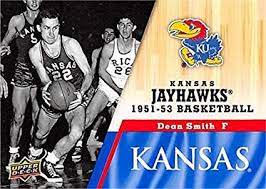
Smith was born in Emporia, KS, and at Topeka High School he was named all-state in basketball as a senior: what made him choose Kansas for college? In high school Dean always held down the coach-on-the-field type of positions: quarterback, catcher, and point guard. KU told him that he could play all three sports, which he did. Additionally, KU offered him an academic scholarship in mathematics. (Note from Kenn: I went to Topeka High eight years after Smith graduated so he has always been a hero to me)

He won the 1952 NCAA title as player for Coach Phog Allen, was NCAA runner-up in 1953, then after graduating he spent 1 year as an assistant to Allen in 1954: what did it mean to him to win a title, and how did he like playing/working for Allen? “Everyone understood that he was going to be a coach”, observed Rich Clarkson, Lawrence Journal-World reporter. Dean certainly appreciated the fact that Allen let him sit next to him on the bench and occasionally asked him for advice. He liked Phog so much that he served briefly as an assistant coach on Allen’s staff before joining the Air Force in 1954.

He was coach of team USA at the 1976 Olympics: what did it mean to him to represent his country, and what did it mean to him to win a gold medal? Even though he did not get the opportunity for revenge against the Russians after the controversial loss to the Soviets in 1972, he nevertheless coached the 1976 team to a perfect 7-0 slate and returned the gold back home to the US. He was proudest of the fact that he became one of only three coaches to have won an NIT title/NCAA title/Olympic gold medal (along with Pete Newell/Bob Knight).

In the 1982 NCAA title game as coach at North Carolina, Michael Jordan made the game-winning jumper with 17 seconds left in a 1-PT win over Georgetown (www.youtube.com/watch?v=qklYkm2jAQ4): how did he like coaching 1 of the greatest athletes in sports history, and what did it mean to him to win a title as a coach (becoming the 2nd person after Bob Knight to win an NCAA title as both a player and a coach)? Before 1982 Smith was always a bridesmaid as a coach, never the bride. 6 times he went to the Final Four…and 6 times he came away empty-handed. He gained the reputation that he could not win the big one. Just before laying that to rest he said, “We are going to determine who wins this game.” He grabbed Jordan and said, “Knock it down.” When they broke the huddle the looks on their faces had changed 180 degrees. The way he talked to them had more to do with winning the national championship than anything else that happened that season. The feelings between Jordan and Smith were mutual. After he graduated Jordan said, “Other than my parents, no one had a bigger influence on my life than Coach Smith. He was more than a coach: he was my mentor, my teacher, my second father. Coach was always there for me whenever I needed him and I loved him for it. In teaching me the game of basketball, he taught me about life.”

Take me through the 1993 Final 4:
In the semifinals he had a 10-PT win over Kansas: how did he feel about facing/beating his alma mater (especially after getting ejected during their previous match-up in the 1991 Final 4)? Of course he had conflicting feelings about beating his alma mater but gaining the win for his Tar Heels. Before the game he said that he would have preferred playing against some other team. He was embarrassed about getting ejected in their previous match-up so the win helped him deal with it.

In the title game Chris Webber got whistled for a technical foul after calling a timeout that his team did not have in a 6-PT loss by Michigan (www.youtube.com/watch?v=aiJxgcka7BA): did he feel weird about winning another title on such a bizarre play? Beating Michigan to obtain his second national championship was great, no matter how bizarre the play was.

He coached for 36 years at North Carolina, was named national COY 4 times, and retired with a D-1 record 879 wins: what made him such a great coach, and what did it mean to him to receive such outstanding honors? When UNC Chancellor William Aycock hired Smith as head coach, he told the 30-year old Smith that wins and losses did not matter as much as running a clean program and representing the university well. True to Aycock’s words, Smith always ran a clean program and represented UNC well. Due to that effort, Aycock kept him on board even while the losses mounted during his first few years, which resulted in the students hanging Smith in effigy. Smith definitely appreciated Aycock’s confidence, and his teams eventually started winning. Smith developed 26 consensus All-Americans, 5 NBA Rookies of the Year (including Jordan), and 25 first-round draft picks.

He was credited with popularizing several techniques including huddling at the FT line before a foul shot, pointing a finger at the player who found his teammate for an AST, and implementing the 4 corners offense: how much credit does he deserve as an innovator, and how much credit goes to his fellow KU alum John McLendon for actually inventing the 4 corners offense? His impact on the strategy/tactics of basketball also extended to many other areas. He implemented the run-and-jump defense, the “tired signal” (where a player would use a hand signal, originally a raised fist, to indicate that he needed to come out for a rest), having the point guard call out the defensive set for the team, and instituting the practice of starting all of his team’s seniors during the final home game of the season (aka “Senior Day”) as a way of honoring the contributions of the subs as well as the stars. During his time as a player/assistant coach at KU, Smith became aware of McLendon’s invention of the 4-corners offense, which was designed to run time off of the game clock while trying to preserve a small lead. The strategy proved to be so successful for Smith that it was adopted by many other teams and later led to the adoption of the shot clock, which kept teams from holding the ball for long periods of time.

96.6% of his athletes received their degrees and he recruited the 1st African-American scholarship basketball player in Tar Heel history (1968 Olympian Charlie Scott): how much importance did he place on academics/racial equality? Smith’s father (Alfred) coached the Emporia High Spartans basketball team to the 1934 state title in Kansas. That team was notable for having the first African-American basketball player in Kansas tournament history. The local school board told him not to do it and he said, “No: I am going to do it or I am going to resign”. They won the state championship…and then nobody complained about having an integrated team anymore! He was a high school senior in 1949, which was five years before the Supreme Court’s historic ruling in Brown vs. (Topeka High) Board of Education. Following his father’s lead, Dean pleaded in vain with officials to include African-American players on the school’s basketball team. Sixteen years later, the Atlantic Coast Conference was all-White. However, he championed racial equality both on and off the court. After completing his fourth season as head coach at North Carolina, he helped promote desegregation in the ACC by recruiting Charlie Scott, the school’s first African-American scholarship player, and pushed for equal treatment for Blacks by local businesses. In 1965 Smith helped Howard Lee, a black graduate student at North Carolina, purchase a home in an all-White neighborhood: 4 years later Lee became the town’s mayor. For his effort and brilliance in dealing with racial inequality, he received the Presidential Medal of Freedom from President Obama in 2013.

His coaching tree is incredible, including Hall of Famers Larry Brown/Billy Cunningham/Roy Williams: how proud was he of the success of all of his former players/assistants? Smith’s coaching tree also includes people such as Bill Guthridge (former national Coach of the Year at UNC), George Karl (whose 1175 career wins remains #6 in NBA history), former UNC coach/KU assistant Matt Doherty (2001 national Coach of the Year at UNC), and Jerry Stackhouse (2-time NBA All-Star and current Vanderbilt coach), to name just a few who went on to future success. He was always proud of his players and continued to communicate with them well after they graduated.

In 2006 he was part of the founding class of the National Collegiate Basketball Hall of Fame and in 2013 he received the Presidential Medal of Freedom: when people look back on his career, how do you think that he should be remembered the most? I was at KU’s basketball centennial celebration in 1998, when a packed crowd at Allen Fieldhouse gave a rousing ovation to Clyde Lovellette, the leading scorer on the 1952 team, but the loudest cheers were reserved for Smith, the backup guard who played a total of 29 seconds in KU’s victory over St. John’s in the 1952 NCAA title game. Here is what others have said about Smith:
Sports Illustrated writer Alexander Wolff : “Time has drawn for us a portrait of someone far more complex than the usual sideline screamer. Smith is a privacy freak who thrived gracefully in an intensely public line of work. He is a traditionalist who will re-jigger anything if reason warrants. We marvel at how a man so stern summons such compassion, and a man so competitive summons such perspective; how he simultaneously tends to niggling detail and sees the big picture; and how he makes his wondrously Jesuitical distinctions.”
Former UNC All-American Phil Ford: “I knew when I signed with North Carolina that I was getting a great coach for four years, but, in addition, I got a great friend for a lifetime.”
Former Duke star Jay Bilas: “If basketball had a Mount Rushmore, Dean Smith’s face would be on it.”

Posted in Interviews | Tagged , , | Comments Off on The Olympians: HoopsHD interviews Kenn Johnson about 1976 Olympic gold medalist Dean Smith

The Hoops HD Report: Pac 12 Conference Preview

CLICK HERE for all of Hoops HD’s Continued and Extensive Preseason Content

Oregon is the team that most of us like to win the league, and probably the team that’s most likely to end up as a protected seed.  UCLA is another team that most of us like considering that all five starters are back, and how strong the Bruins were playing down the stretch at the end of last season.  Arizona State and Stanford are two other likely NCAA Tournament teams, and Colorado and Utah are worth keeping an eye on as well.  Watch and/or listen as we run through all the teams in the conference…

And for all you radio lovers, below is an audio only version of the show…

Posted in Conference Preview, Hoops HD Report, Podcasts, Videocasts | Tagged | Comments Off on The Hoops HD Report: Pac 12 Conference Preview

2020 Draft Preview: HoopsHD interviews Rhode Island prospect Jeff Dowtin

On May 1st the NBA’s Board of Governors voted to postpone the Draft Lottery and Draft Combine in Chicago due to an abundance of caution regarding the coronavirus pandemic. In addition to all of the seniors who have wrapped up their college careers, the early-entry deadline for underclassmen was August 3rd. The lottery took place on August 20th and the draft is scheduled to take place on November 18th. We will spend the upcoming days interviewing as many members of the 2020 draft class as possible. HoopsHD’s Jon Teitel concludes our coverage by chatting with Jeff Dowtin about being a good PG and what it would mean to him to get drafted.

You were born/raised in Maryland: what made you choose Rhode Island? I grew up in Upper Marlboro, and there were a few other people from the area who had went up to Rhode Island such as Stanford Robinson/David Cox. It was a great fit for me.

You played 2 years for Dan Hurley and 2 years for David Cox: what is the biggest difference between your 2 coaches? Their style of coaching. Coach Hurley is a lot more energetic/hyper and in your face, while Coach Cox is a lot more laid back/chill.

In February 2018 after missing your only FT attempt in a 3-PT loss at St. Bonaventure as a sophomore you returned to campus at 3AM, went straight to the gym, and practiced FTs for the next several hours: how exhausted were you during your 9AM class that morning, and how did it feel to make 11-12 FTs during your next game a few days later (a 2-PT OT win at La Salle)? That is a true story. I spent at least 3 hours in the gym that morning and then slept in the locker room before heading to class. It was all worth it in the end: I just had to put in some extra work.

You finished that year by leading the conference with 189 AST: what is the secret to being a good PG? Just protecting the ball is the main part: you want more AST than TO. The 2nd part is to get your teammates involved and have a feel for the game and find them in spots where they are comfortable scoring from.

Last January the NCAA suspended you for 1 game because you had played in a charity game the previous summer: now that you are no longer in college, how do you really feel about the NCAA?! I am a basketball junkie and just love playing. I was invited to a charity game and just went there to have fun. I did not agree with the NCAA’s decision: as long as you are not taking any benefits I think that you should be able to participate.

You were named to the A-10 All-Academic Team during each of the past 3 years: how did you balance your work on the court with your work in the classroom? It is easier for me to perform on the court when there are no distractions off the court, so as long as I am going to class and turning in my assignments then I can focus on helping my team win.

You were scheduled to play in the A-10 tourney last March before learning that the NCAA tourney was canceled due to the coronavirus: what was your reaction when you 1st heard the news, and do you think that it was the right decision? I was definitely hurt/distraught: I wanted to go out with a bang during my senior year. However, you have to think about the health/safety of everyone so I feel that they did make the right decision.

Another player hoping to get drafted is your former high school teammate Anthony Cowan Jr., who you have known since you were 10 years old: what was he like back in the day, and do you think that we will see him in the NBA? Anthony is a cool dude: we played together for several years in high school. He is a great PG and 1 of the fastest guys I ever played with so I hope that he makes it.

What is it like to be an African-American man in 2020? It has been challenging my whole life to be a Black man in the US. We are constantly fighting for change/equality and it has definitely taken a toll on everyone. It has been hard to fight the status quo but we will continue to fight.

What would it mean to you to get drafted, and what is the plan if you do not get drafted? It would mean the world to me and show that my hard work has paid off. If it does not happen it does not mean that it is the end of the road: I just have to stay humble and will continue to work hard.

Posted in Interviews | Tagged , | Comments Off on 2020 Draft Preview: HoopsHD interviews Rhode Island prospect Jeff Dowtin

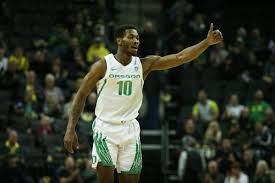
2020 Draft Preview: HoopsHD interviews Oregon prospect Shakur Juiston

On May 1st the NBA’s Board of Governors voted to postpone the Draft Lottery and Draft Combine in Chicago due to an abundance of caution regarding the coronavirus pandemic. In addition to all of the seniors who have wrapped up their college careers, the early-entry deadline for underclassmen was August 3rd. The lottery took place on August 20th and the draft is scheduled to take place on November 18th. We will spend the upcoming days interviewing as many members of the 2020 draft class as possible. HoopsHD’s Jon Teitel continues our coverage by chatting with Shakur Juiston about being a clutch player and what it would mean to him to get drafted.

In 2017 you were named NABC Junior College POY/tourney MVP at Hutchinson Community College: what did it mean to you to win such outstanding honors, and what did it mean to you to win a title? It really meant a lot. Just to be in the atmosphere of a championship gave me a lot of confidence: going out and competing was the most thrilling part. It was a great time in my life and is 1 of the biggest accomplishments in my life.

You averaged 14.6 PPG/10 RPG in your 1st year at UNLV: how were you able to come in and contribute right from the start? That was part of my whole recruitment: they put me in a position to be successful and they thought that I was their missing piece.

The following year you played in just 8 games before suffering a knee injury and earning a medical redshirt: how bad was the injury, and how were you able to get back onto the court? The pain was tolerable but my knee was not going to be stable so I decided to get surgery. I feel 100% now and can still jump/move/cut.

Why did you decide to transfer, and what made you choose Oregon? My coach at UNLV (Marvin Menzies) got fired so I was just weighing my options for my final year. The Ducks have a history of building good teams and I thought that I could be a good addition.

You played for Coach Dana Altman: what makes him such a good coach, and what was the most important thing that you ever learned from him? He is very open-minded and will listen to his players to get feedback. He made us feel relaxed and everything was very open: he hears us out and puts us in the best position to play our best.

You had 2 game-winning baskets last season in the final seconds: what is the key to being a clutch player? I just like to be ready whenever the opportunity presents itself. I do not try to force things because anything can go wrong. I was just at the right place at the right time and had the right intentions.

You were scheduled to play your in-state rival Oregon State in the Pac-12 tourney last March before learning that the NCAA tourney was canceled due to the coronavirus: what was your reaction when you 1st heard the news, and do you think that it was the right decision? We got the news at breakfast the day before the game so it was heartbreaking to end our season like that. However, we did win the regular season title and get a trophy so that was good enough for me.

Another player hoping to get drafted is your former teammate Payton Pritchard, who was named 1st-team All-American/conference POY: what makes him such a good player, and do you think that we will see him in the NBA next year? His work ethic is 1 of the best that I have ever seen. Before practice, after practice, in the weight room, nutrition: everything he does is to get better each and every day. I would not be surprised if he makes it to the NBA and then shocks a lot of people who doubted him.

What is it like to be an African-American man in 2020? I stay away from politics and just try to keep focused/remain neutral. I have a lot of different friends who feel a certain way so I am not about to judge anyone. I cannot dwell on the past and put the burden on anyone else.

What would it mean to you to get drafted, and if not then do you still want to become a coach? It would mean a lot to both me and my family to see what can be accomplished when you put your mind to it. I would like to keep playing even if I do not get drafted because I love the game. The NBA is the ultimate goal but I will not stress about it. I still want to be a coach someday: basketball is my life.

Posted in Interviews | Tagged , | Comments Off on 2020 Draft Preview: HoopsHD interviews Oregon prospect Shakur Juiston

Happy Draft-iversary!: HoopsHD interviews Tim Healey about former ASU star Eddie House

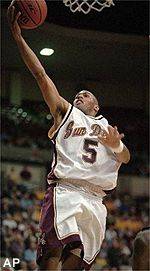
With the 2020 NBA draft taking place this week we will spend the days ahead taking a walk down memory lane with a choice collection of players who are celebrating an awesome anniversary this year. From the 1st player in NBA history to score 2000 PTS in a season (70th anniversary) through the 2000 Pac-10 POY (20th anniversary), these stars have all seen their dreams come true in past drafts. We conclude our series with Eddie House. He scored 61 PTS in a game as a senior in Tempe, was named conference POY in 2000, and won an NBA title with Boston in 2008. HoopsHD’s Jon Teitel got to speak with ASU play-by-play man Tim Healey about the 20th anniversary of House getting drafted.

House was born in Berkeley and originally wanted to go to college at Cal: what made him choose ASU? Bill Frieder was the coach at the time and was a terrific recruiter. We always listed “Union City” as his hometown on the roster and he later scored 61 PTS in his hometown. He played for 3 different coaches in 4 years: Frieder, Don Newman (who took the team to the NIT and knocked off Stanford on the road), and Rob Evans (who was head coach at Old Miss).

As a senior he set a school record by scoring 61 PTS/18-19 FT in a 111–108 2-OT win over Cal (www.youtube.com/watch?v=WpqUzkRe8as): was it just 1 of those scenarios where every shot he put up seemed to go in because he was “in the zone”? He was: the fact that proves it is that he only made 1 layup (everything else was a jumper or 3-PT shot). ASU needed every single 1 of those PTS because it was a double-OT game. Both of those teams started a lot of freshmen: Eddie was 1 of the few “grizzled veterans”. It was a remarkable performance: his signature shot was a fadeaway 3 at the end of the 1st OT.

He graduated as the all-time leading scorer in school history: did you realize at the time how prolific a player he was, and do you think that anyone will ever break his record? The memory I have of his senior year is that he was just having 1 of those years where he could go off for 40 PTS any single night (which he did on 4 separate occasions). He even had 40 PTS against my alma mater (Penn State) in their holiday tournament. He also had 40 when they beat UCLA for the 1st time in more than a decade. He could really create his own shot and had a quick release.

He also holds the school record for career STL: how did he balance his offense with his defense? He had quick hands/feet and was a real pest on defense. He was a really good all-around player.

In 2000 he was named conference POY: what did it mean to him to receive such an outstanding honor? I am sure it was a huge honor both for him and the school. ASU has struggled to maintain consistent competitive balance over the years. They had some glory days in the 1960s/1970s with Ned Wulk (basketball)/Frank Kush (football) before they joined the Pac-8 along with Arizona. When Bobby Hurley 1st took his team to the NCAA tourney it was just the 6th time since Wulk was fired, and he is doing a great job on the recruiting trail. It has been an uphill struggle but for a program that was an afterthought to have a player become the league’s leading scorer was quite a feather in the cap. He brought exposure to the program and catapulted himself to the top of the heap. His record might never be broken because if a player is prolific enough at scoring as Eddie was then he will likely not stay in college for 4 years.

In the 2000 NBA draft he was selected 37th overall by Miami (6 spots ahead of Michael Redd): did you see that as a validation of his college career, or the realization of his lifelong dream of reaching the NBA, or other? I am sure that it meant everything to him: what kid would not be thrilled? It also meant a lot to ASU: they had several players make the NBA in the 1970s/early 1980s but then had a lull for a long time. When you go 10 years without making an NCAA tourney it probably means you do not have enough good players. Just to get drafted and forge a nice career for a long time was very gratifying/rewarding, both for him and the fans.

In Game 4 of the 2008 NBA Finals as a player for Boston he overcame a 24-PT deficit on the road to win by 6 PTS: what did it mean to him to win a title? All of the Sun Devils were proud of him. ASU baseball fans take a lot of pride in all of their great players like Dustin Pedroia/Jason Kipnis/Andre Ethier, and ASU football fans love Terrell Suggs, who will probably end up in the Hall of Fame. It comes in the context of a school that has simply not had a lot of NBA players during the past 30 years.

In 2009 he broke Danny Ainge’s Celtics team record for best 3P% in a season with 44.4%: what was his secret to making shots from behind the arc? He just had the God-given gift to fill it up from outside: he had great range. He had deadly accuracy both in college and the pros.

He married Mike Bibby’s sister (before later becoming his teammate), his cousin Danuel House is in the NBA, and his son Jaelen played 30 games for the Sun Devils last year as a freshman: who is the best athlete in the family? I know that Eddie would definitely say it is him! He was a good talker on the floor and will be the 1st to admit it, but he could also back it up.

When people look back on his career, how do you think that he should be remembered the most? As 1 of the greatest players this school has ever produced: the numbers show it. This program has a proud history/tradition but nobody ever scored more PTS than Eddie. He improved each year and his senior year was as good as I have ever seen. When fans think about the greatest I think there are others in the conversation, but House is certainly at the top.

Posted in Interviews | Tagged , , | Comments Off on Happy Draft-iversary!: HoopsHD interviews Tim Healey about former ASU star Eddie House

The Hoops HD Report: Big Ten Preview

CLICK HERE for all of Hoops HD’s Continued and Extensive Preseason Content

This conference appears to be stacked this year with seven teams cracking the preseason Top 25, and about one or two more right behind that.  Iowa has one of the best players in the country and may be a Final Four contender, Wisconsin is another team that we could see going deep in March, and Illinois is much improved from a year ago.  Michigan State and Michigan are also in the mix, and let’s not forget Rutgers who returns most of their key players from a very successful season last year.  We discuss them and everyone else in the league.

And for all you radio lovers, below is an audio only version of the show…

Posted in Conference Preview, Hoops HD Report, Podcasts, Videocasts | Tagged | Comments Off on The Hoops HD Report: Big Ten Preview